Denial Management
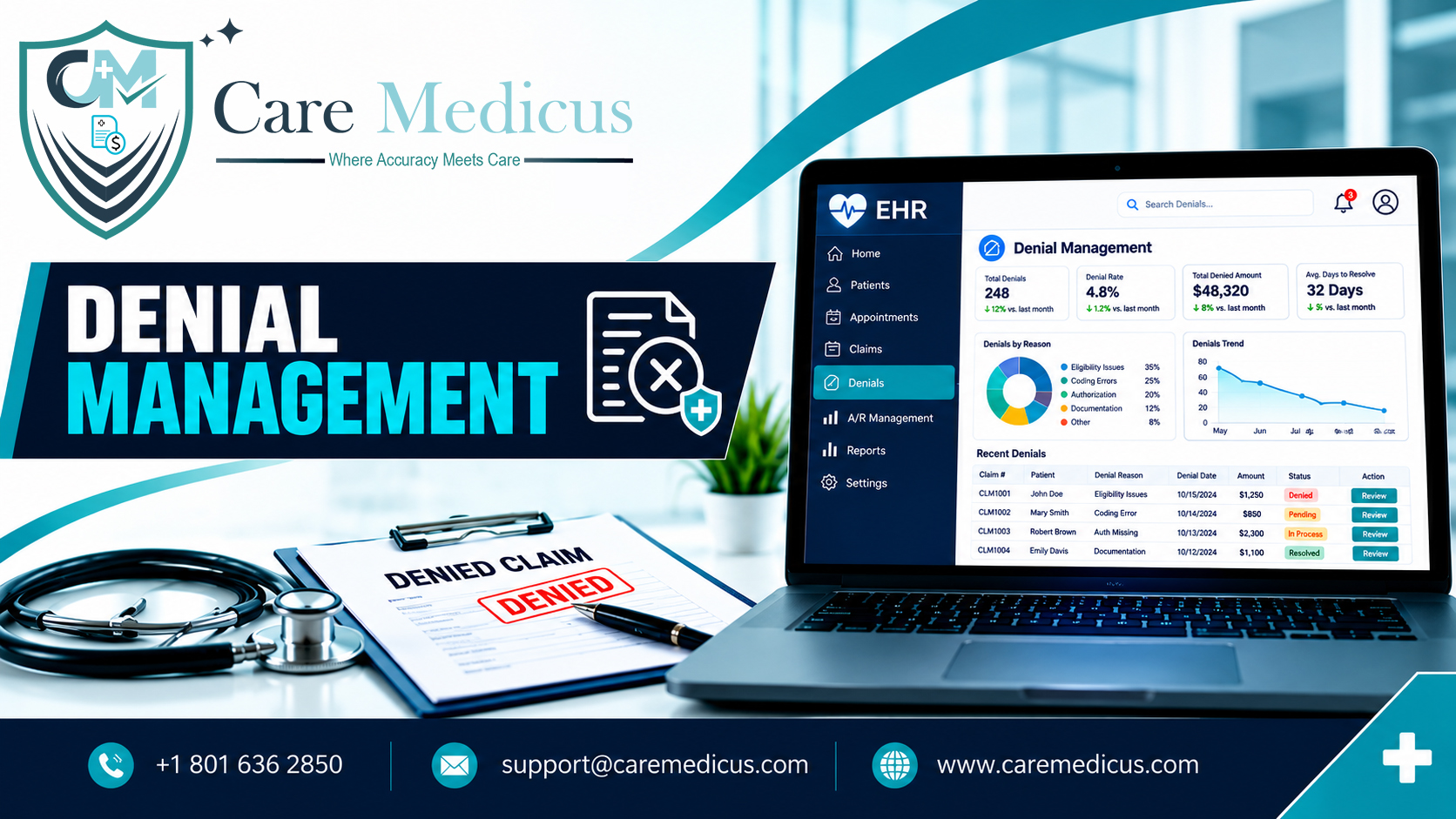
When insurance claims are denied, the problem is rarely limited to a single unpaid claim. Unresolved denials can create aging accounts receivable, increase administrative workload, delay reimbursement, and allow preventable revenue leakage to continue. Care Medicus LLC provides structured denial management services designed to help you understand why claims are denied, determine the appropriate corrective action, and move eligible claims toward resolution. With more than 10 years of healthcare billing experience and 24/7 service availability, we support practices that need a consistent process for denial analysis, root cause identification, appeals management, corrected claims, and denial trend reporting.
Take Control of Insurance Claim Denials Before They Affect Your Revenue
Denial management is the process of identifying, analyzing, correcting, appealing, and monitoring insurance claims that payers have denied. It is an important part of medical billing because a denial does not automatically mean the revenue is permanently lost. Some denials may be resolved through corrected claims, additional documentation, payer reconsideration, or a formal appeal. Others may reveal larger workflow problems involving eligibility verification, prior authorization, coding, documentation, timely filing, or payer-specific billing requirements.
Care Medicus LLC helps you take a more organized approach to denial management. Instead of treating every denial as an isolated problem, our process focuses on the reason behind the denial and the action required to address it. We review available remittance information, denial codes, claim history, payer requirements, and supporting documentation to determine whether correction, resubmission, reconsideration, or appeal is appropriate.
Our workflows can incorporate healthcare revenue cycle and analytics resources such as Inovalon, R1 RCM, Rivet, and Honey Health, along with your practice management system, clearinghouse, EHR, and payer portals where applicable. These tools and data sources can support claim analysis, payment review, denial categorization, and reporting.
You receive more than follow-up activity. You gain visibility into recurring denial patterns that may be affecting your reimbursement. By identifying trends and connecting denials to underlying causes, your practice can take corrective action and reduce the risk of repeating the same errors.


Common Denial Management Problems We Solve
Recurring Denials With No Clear Root Cause
Recurring denials can become one of the most frustrating problems in medical billing because the same issue may appear under different patients, payers, providers, or procedures. A practice may repeatedly correct individual claims without identifying the underlying cause. Common sources include eligibility errors, missing prior authorization, modifier issues, incorrect diagnosis coding, incomplete documentation, coordination of benefits problems, or payer-specific billing requirements. Without structured root cause identification, your staff may continue spending time on the same type of denial while accounts receivable grows and reimbursement remains delayed.
Care Medicus LLC starts with denial analysis and root cause identification. We review available denial information, including remittance codes, claim history, payer responses, documentation requirements, and recurring patterns. Using benchmark reporting and workflow resources available in the market, we help categorize denials and identify whether multiple claims share a common corrective action. Our team then supports a targeted response, whether that involves corrected claims, documentation follow-up, appeals management, or a workflow adjustment. For active denial queues, issues can be prioritized based on filing deadlines, aging, and available claim information rather than simply being handled in random order.
Effective denial management requires more than resubmitting every unpaid claim. First, we review why the payer denied the claim and determine whether the stated reason reflects a correctable error, a missing requirement, a documentation issue, or a broader process problem. For example, several denials that initially appear unrelated may share the same root cause, such as an outdated eligibility workflow or recurring modifier issue. Identifying that connection allows your practice to address the problem at its source.
We organize denial information into meaningful categories and review trends by payer, denial reason, provider, procedure, and other available data points. When multiple denials support the same conclusion, a single corrective workflow may help prevent repeated rework. This approach also helps distinguish isolated claims from systemic issues that require broader attention.
Our goal is to give your practice a practical path forward. Claims are evaluated for the next appropriate action, while recurring patterns are documented for corrective planning. This creates a more efficient workflow and helps your staff focus on issues with the greatest potential impact. You can contact Care Medicus LLC at +1 801 636 2850 to discuss your current denial challenges.
Missed Appeal Deadlines and Aging Denied Claims
Denied claims often require action within specific payer timeframes. When a denial sits in an aging queue too long, your practice may lose the opportunity to submit a corrected claim, request reconsideration, or file an appeal. Small billing teams can struggle to manage these deadlines while also handling new claims, payment posting, patient inquiries, and routine accounts receivable follow-up. The longer a potentially recoverable claim remains unresolved, the greater the risk of missed filing limits and delayed cash flow.
Care Medicus LLC helps organize denied claims according to available appeal deadlines, timely filing requirements, claim aging, payer instructions, and documentation needs. We review the denial reason and determine the appropriate next step, such as submitting a corrected claim, preparing supporting documentation, requesting reconsideration, or pursuing an appeal where appropriate. Our workflows can use practice data, payer portals, and analytics resources to support claim prioritization and follow-up. Claims approaching critical deadlines can be identified for prompt review, helping your practice reduce the risk of losing available recovery opportunities simply because a denial was not addressed in time.
Not every denied claim should receive the same response. Some claims require a simple correction, while others may require medical records, additional documentation, a payer reconsideration request, or a formal appeal. Our team evaluates the available information before determining which path is appropriate. This helps prevent unnecessary resubmissions and supports a more focused use of administrative resources.
For appealable claims, we organize the relevant claim information and supporting materials according to the payer’s available requirements and deadlines. For correctable claims, we focus on addressing the identified issue before resubmission. We also document the action taken so your practice has a clearer record of claim activity and follow-up.
Priority is given to claims based on factors such as aging, filing deadlines, denial reason, and the information available for resolution. This does not guarantee payment, because final reimbursement decisions remain with the payer, but it helps ensure potentially recoverable claims receive structured attention before available deadlines pass. With 24/7 service availability, Care Medicus LLC can support ongoing denial workflows around your operational needs.
Corrected Claims Are Resubmitted Without Fixing the Underlying Error
A corrected claim can be an appropriate response when the original denial resulted from inaccurate or incomplete claim information. However, repeatedly correcting and resubmitting claims without identifying the actual cause can lead to repeated denials and wasted staff time. Common problems include incorrect patient demographics, coding errors, modifier issues, missing claim details, payer identification errors, or coordination of benefits conflicts. If the same error remains in the workflow, the practice may continue generating new claims with the same problem.
Care Medicus LLC reviews the denial reason and compares it with available claim and billing information before preparing a corrected claim for the appropriate workflow. We examine relevant data from your practice management system, EHR, clearinghouse, payer portals, and revenue cycle resources such as Rivet and Honey Health where applicable. The objective is not simply to change information and resubmit. We identify what triggered the denial, determine whether the claim can be corrected, and document the issue so recurring errors can be monitored. Correctable claims can then move through a structured resubmission process while systemic issues are flagged for additional review.
Corrected claims require attention to both accuracy and timing. After identifying a correctable issue, our team reviews the information needed to address the denial, such as coding details, patient information, payer data, documentation, or other claim elements. We then follow the appropriate corrected-claim workflow based on the available payer instructions and your established billing processes.
The same denial reason is also evaluated for potential recurrence. If multiple claims show a similar issue, we can group them into a trend for further analysis rather than treating each claim independently. This may reveal an upstream process problem that requires attention in registration, eligibility verification, authorization, charge capture, coding, or claim preparation.
This approach helps reduce repetitive work and provides a clearer distinction between one-time corrections and recurring billing issues. Claims can be reviewed and prioritized according to their status, aging, and applicable filing requirements. Care Medicus LLC supports this process as part of a broader denial management strategy focused on both claim resolution and prevention.
Denial Trends Are Hidden Across Different Payers and Claim Types
Individual claim follow-up can make it difficult to see the larger picture. A practice may know that it has many denials but lack visibility into which payers, procedures, providers, or denial reasons are contributing most to the problem. Without denial trend reporting, management decisions may be based on assumptions instead of measurable patterns. Recurring denials can continue unnoticed, revenue leakage may increase, and staff may spend significant time resolving symptoms rather than addressing the source of the problem.
Care Medicus LLC provides denial trend reporting to help organize available denial data into actionable categories. We can review patterns by payer, denial reason, claim type, procedure, provider, and other relevant data available through your billing systems. Analytics and revenue cycle resources support data visibility depending on your existing technology environment and authorized workflows. Reporting helps identify recurring patterns, prioritize problem areas, and support corrective action planning rather than relying only on manual claim-by-claim review.
Our Denial Trend Reporting and Prevention Strategy
Denial reporting becomes valuable when it leads to action. Our approach focuses on identifying patterns and connecting them to possible operational causes. For example, a recurring group of authorization-related denials may indicate a workflow issue before services are rendered, while repeated coding denials may point to documentation or claim preparation concerns.
We organize available denial information so your practice can better understand where problems are occurring and which categories deserve priority. Trends can be reviewed over defined reporting periods and compared against changes in workflows or payer requirements when relevant information is available.
The result is a more structured approach to denial prevention. Instead of waiting for the same problem to generate another unpaid claim, your practice can use recurring denial information to review processes and implement appropriate corrective actions. This may reduce avoidable rework and improve the efficiency of your revenue cycle over time.
Care Medicus LLC combines denial analysis, root cause identification, corrected claims, appeals management, and trend reporting into a coordinated workflow.
Our Denial Management Process
Step 1: Review and Categorize the Denial
Every denial starts with understanding what the payer communicated and what information is available in the claim record. Our team reviews denial reasons, remittance information, claim history, payer correspondence, and relevant documentation. We then categorize the denial according to the available information, such as eligibility, authorization, coding, documentation, timely filing, duplicate billing, coordination of benefits, or another payer-specific issue.
Categorization creates a stronger foundation for follow-up because it prevents all denials from being handled as if they require the same response. A missing modifier may require correction, while a medical necessity denial may require additional documentation or an appeal. A timely filing denial may require review of submission records and applicable payer rules.
This initial review also helps determine urgency. Claims with approaching appeal deadlines or filing limits may require faster attention than claims with more time available. By organizing the denial queue around both reason and timing, Care Medicus LLC helps your practice establish a more controlled workflow for denied insurance claims.
Step 2: Identify the Root Cause
After categorizing the denial, we look beyond the individual claim to determine whether the issue is isolated or recurring. Root cause identification examines the underlying process that may have contributed to the denial. This can include registration, eligibility verification, prior authorization, documentation, coding, charge capture, claim submission, or payer-specific requirements.
Multiple denials can sometimes have the same corrective action. For example, several claims denied for related demographic or eligibility issues may point to a front-end registration problem. Likewise, recurring modifier denials may indicate a billing or coding workflow that requires review. Identifying these relationships helps prevent staff from repeatedly solving the same issue one claim at a time.
Care Medicus LLC uses available claim data, reporting, payer information, and authorized technology resources to organize these patterns. The objective is to develop a practical corrective path for individual claims while identifying broader opportunities to reduce future denials.
Step 3: Correct, Resubmit, or Appeal
Once the denial has been analyzed, we determine the appropriate next action based on the available claim information and payer requirements. A correctable claim may be prepared for correction and resubmission. A denial requiring additional evidence may move toward reconsideration or appeals management. Claims may also require supporting medical records, documentation, or other information before additional action is taken.
This distinction matters because resubmitting a claim without correcting the underlying issue can result in another denial. Similarly, appealing a claim that can be resolved through a straightforward correction may create unnecessary administrative work.
Our team supports a structured workflow that matches the response to the denial. Available payer deadlines and timely filing requirements are considered when prioritizing the work. While no appeal or corrected claim can guarantee reimbursement, a well-organized process helps ensure that eligible follow-up opportunities are evaluated before critical deadlines pass.
Step 4: Monitor Trends and Improve the Process
The final stage of denial management focuses on learning from the data. Denial trend reporting helps identify recurring patterns that may otherwise remain hidden in a large claim queue. We review available data to identify concentrations of denials by reason, payer, provider, procedure, or other meaningful categories.
These findings can support corrective action. If a particular denial reason continues to increase, the underlying workflow can be reviewed. If a specific payer consistently denies claims for a recurring requirement, your practice can adjust its process based on applicable payer guidance.
This creates a continuous cycle of analysis, correction, follow-up, and prevention. Over time, the objective is to reduce avoidable administrative work and give your practice better visibility into denial-related risks.
Why Choose Care Medicus LLC for Denial Management?
More Than 10 Years of Medical Billing Experience
With more than a decade of experience supporting medical billing and revenue cycle workflows, Care Medicus LLC understands that denial management requires both detailed claim review and a broader understanding of how denials affect your practice. An unpaid claim can impact more than a single account. It can create follow-up work, increase accounts receivable, delay cash flow, and consume staff resources that could otherwise be focused on patient service and current billing activity.
Our approach combines individual claim follow-up with denial analysis and trend identification. This allows us to address immediate issues while also looking for recurring causes. We work with the information available in your billing environment and support workflows involving practice management systems, EHRs, clearinghouses, payer portals, and healthcare technology resources.
Our service is designed to support small and growing healthcare practices that need additional billing capacity without losing visibility into their revenue cycle.
Structured Root Cause Identification
Simply knowing that a claim was denied is not enough. Your practice also needs to understand whether the denial represents an isolated event or part of a larger recurring issue. Our structured approach to root cause identification helps separate individual corrections from systemic problems.
We review available denial reasons and claim information, then organize recurring issues into meaningful categories. When patterns emerge, they can be connected to specific parts of the revenue cycle, such as eligibility, authorization, documentation, coding, or claim submission.
This approach can reduce repetitive manual work by allowing similar denials to be reviewed together when they share the same underlying cause. It also supports more informed corrective action, helping your practice focus on process improvements that may reduce repeated denials in the future.
Appeals, Corrected Claims, and Denial Follow-Up
Denied claims do not all follow the same path. Some may need correction and resubmission, while others may require additional documentation, reconsideration, or a formal appeal. Care Medicus LLC helps determine the appropriate workflow based on the available denial information and applicable payer requirements.
We also consider timing. Appeal deadlines and timely filing limits can affect whether a claim remains eligible for additional follow-up. Organizing claims by urgency and next action helps prevent important opportunities from being overlooked.
Our goal is to bring consistency to the denial follow-up process. Rather than allowing denied claims to remain scattered across aging reports and work queues, we help establish a clearer process for review, action, and documentation.
24/7 Support for Ongoing Billing Workflows
Medical billing issues do not always fit neatly into standard office hours. Your practice may need assistance with denial queues, claim follow-up, reporting, or billing workflows based on your operational requirements. Care Medicus LLC provides service availability 24 hours a day, 7 days a week.
This availability can support practices with different schedules, distributed teams, or ongoing revenue cycle needs. It also provides an option when your internal staff requires additional administrative support during periods of high workload.
Frequently Asked Questions About Denial Management
What Is Denial Management in Medical Billing?
Denial management is the structured process of reviewing insurance claims that a payer has denied and determining the appropriate next action. This can include denial analysis, root cause identification, corrected claims, resubmissions, reconsideration requests, appeals management, and trend reporting.
The purpose is not simply to work through a list of unpaid claims. Effective denial management also examines why denials occur and whether the same issue is affecting multiple claims. For example, repeated eligibility-related denials may point to a front-end verification issue, while recurring coding denials may indicate a documentation or billing workflow that needs attention.
Care Medicus LLC helps practices organize this process by reviewing denial information, prioritizing claims based on available deadlines and aging, and identifying opportunities for correction or appeal. We also support denial trend reporting to help your practice identify recurring patterns.
What Is the Difference Between a Claim Rejection and a Claim Denial?
A claim rejection and a claim denial occur at different stages of the billing process. A rejection generally occurs before the claim completes the payer’s adjudication process. It may result from missing or invalid information, formatting problems, or other submission issues that prevent the claim from being processed.
A denial generally occurs after the payer has processed or adjudicated the claim and determined that payment will not be made as submitted. The reason may involve eligibility, authorization, coding, medical necessity, documentation, coverage limitations, or other payer requirements.
Both require follow-up, but the appropriate response can differ. Rejected claims may need correction and resubmission, while denied claims may require additional analysis, documentation, reconsideration, correction, or appeal.
What Causes Insurance Claims to Be Denied?
Insurance claims can be denied for many reasons. Common causes include inactive coverage, incorrect patient information, missing prior authorization, coding errors, modifier problems, insufficient documentation, medical necessity requirements, duplicate billing, coordination of benefits issues, non-covered services, and timely filing limitations.
Payer-specific policies can also affect claim outcomes. A claim that meets one payer’s requirements may require additional information or a different workflow for another payer.
Because denial causes vary, Care Medicus LLC reviews available remittance information, claim details, payer responses, and documentation before determining the next action. This helps distinguish between claims that can be corrected and resubmitted and claims that may require additional documentation or appeals management.
Can Multiple Denials Have the Same Corrective Action?
Yes. Multiple denials can share the same root cause and may require a similar corrective action. For example, several claims denied because of the same demographic data issue may indicate a registration workflow problem. A group of modifier denials may reveal a recurring coding or billing process issue.
Identifying these patterns is an important part of denial management because it allows your practice to address the underlying problem rather than repeatedly correcting individual claims.
Care Medicus LLC uses denial analysis and trend reporting to identify recurring categories. When a common cause is identified, similar claims can be reviewed more efficiently, and the relevant workflow can be evaluated for improvement.
When Should a Denied Claim Be Corrected Instead of Appealed?
A denied claim may be corrected when the issue involves inaccurate, incomplete, or missing information that can be legitimately updated according to the applicable payer requirements. Examples can include certain demographic errors, coding corrections, missing claim details, or other correctable submission issues.
An appeal may be appropriate when your practice believes the claim was denied incorrectly or when additional documentation and explanation are needed to support the original service or billing decision.
The appropriate response depends on the denial reason, payer instructions, available documentation, and applicable deadlines. Care Medicus LLC reviews these factors to help determine whether correction, resubmission, reconsideration, or an appeal is the more appropriate next step.
How Do You Identify the Root Cause of Recurring Denials?
Root cause identification starts by organizing denials into categories and reviewing patterns across multiple claims. We look at available factors such as denial reason, payer, provider, procedure, coding, authorization status, eligibility information, documentation, and claim history.
When similar issues appear repeatedly, we evaluate whether they connect to the same part of the revenue cycle. For example, repeated prior authorization denials may indicate an authorization workflow problem, while recurring eligibility denials may point to verification or registration issues.
This process helps distinguish isolated claim problems from systemic patterns that may require workflow changes.
How Long Do You Have to Appeal a Denied Claim?
Appeal timeframes vary by payer, plan, contract, denial type, and applicable policies. Some claims may have relatively short deadlines, while others may allow more time. Because deadlines differ, it is important to review the payer’s remittance information and applicable appeal requirements as soon as possible.
Care Medicus LLC helps organize denied claims according to available deadlines and claim aging. Claims approaching a filing or appeal deadline can be prioritized for review based on the information available.
You should not assume that every denied claim can be appealed indefinitely. Timely follow-up is important for preserving available options.
Can Denial Management Help Recover Unpaid Revenue?
Denial management can help identify potentially recoverable claims and determine the appropriate next action. Depending on the denial reason and available information, a claim may be corrected, resubmitted, reconsidered, or appealed.
Recovery is not guaranteed because payment decisions ultimately depend on payer requirements, coverage rules, documentation, and the facts of each claim. However, a structured denial management process helps ensure that claims are reviewed rather than simply being left unresolved.
By prioritizing claims according to aging, deadlines, and denial reasons, your practice can focus its follow-up efforts more effectively.
What Is Denial Trend Reporting?
Denial trend reporting organizes denial data to identify recurring patterns. Reports may show trends by payer, denial reason, provider, procedure, claim category, or other available data points.
This information helps your practice understand whether certain types of denials are increasing or recurring. Instead of relying only on individual claim follow-up, you can use trend data to investigate broader process issues.
Care Medicus LLC uses denial trend reporting as part of its overall approach to root cause identification and denial prevention.
Do You Provide Denial Management Support 24/7?
Yes. Care Medicus LLC provides 24/7 service availability for denial management and related medical billing workflows.
Our support can include denial analysis, root cause identification, appeals management, corrected claims, claim follow-up, and denial trend reporting based on your practice’s established processes and requirements.
Start Building a More Controlled Denial Management Process
Insurance claim denials can affect cash flow, increase accounts receivable, and place additional pressure on your billing staff. A structured denial management process helps you understand what happened, determine the appropriate next step, and identify recurring issues before they continue affecting new claims.
Care Medicus LLC provides support for denial analysis, root cause identification, appeals management, corrected claims, and denial trend reporting. With more than 10 years of experience and 24/7 availability, we help healthcare practices create a more organized approach to denied insurance claims.
If your practice is dealing with recurring denials, aging denied claims, missed follow-up opportunities, or limited visibility into denial trends, now is a good time to review the underlying process.