Charge Capture
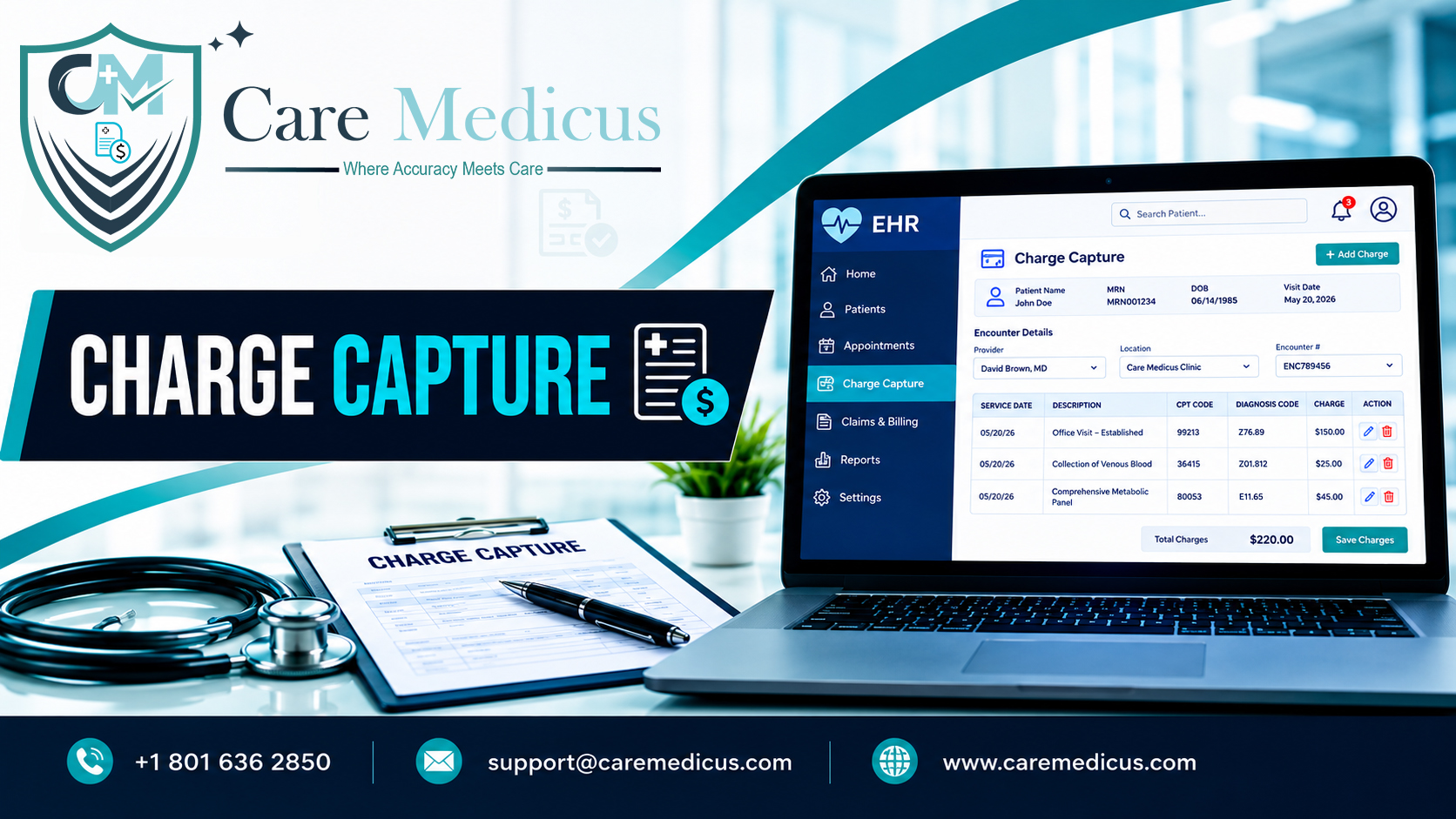
Accurate charge capture is one of the earliest opportunities to protect revenue in your medical billing process. Every patient encounter represents services that may need to be documented, coded, validated, and translated into appropriate charges. When a service is missed, entered incorrectly, assigned an inappropriate diagnosis code, or submitted with an incorrect procedure code or modifier, your practice may face preventable claim problems or leave legitimate revenue unbilled.
Care Medicus LLC provides charge capture support 24/7, helping healthcare organizations review charges before they move further through the revenue cycle. With more than 10 years of experience, our team focuses on four critical areas: DX code validation, CPT code validation, G-code and modifier validation, and missing charge identification.
Our specialists can work with charge capture and revenue cycle technologies including SwiftPay MD, Updox, Claimocity, Ingenious Med (TRIO), and Medaptus (Charge Pro), depending on your existing workflow and technology environment.
The objective is straightforward: help you capture the services that were actually performed, connect charges with appropriate documentation, identify discrepancies earlier, and reduce avoidable revenue leakage.

Why Charge Capture Matters to Your Medical Billing Revenue Cycle
Charge capture is the process of identifying the billable services associated with a patient encounter and ensuring those services are accurately represented in the billing workflow. Although it may appear to be a simple step, charge capture connects clinical activity with the financial side of healthcare. If the services documented during an encounter do not make it into the billing system correctly, downstream teams may have nothing accurate to submit to the payer.
This makes charge capture an important part of revenue cycle management (RCM) and revenue integrity. Accurate charge capture can help your practice identify missed services, validate procedure information, review diagnosis-code relationships, and detect issues before claims are submitted.
At Care Medicus LLC, our approach includes DX code validation, CPT code validation, G-code and modifier validation, and missing charge identification. These reviews help your practice establish a more consistent connection between patient encounters, provider documentation, charges, and claims.
For example, a provider may document several services during a patient encounter, but an incomplete charge entry could result in one of those services never reaching the billing workflow. A modifier may also be missing or inappropriate, or a CPT code may not align with the available documentation. These discrepancies can create claim rework, payment delays, denials, or revenue leakage.
Our specialists use established workflows and available technology such as Claimocity, SwiftPay MD, Ingenious Med (TRIO), Medaptus (Charge Pro), and Updox to support charge review and reconciliation.
You should not have to discover missed charges months after the original encounter. A structured charge capture process gives your practice an opportunity to identify issues closer to the point where they occur.
Common Problems During Charge Capture We Solve
Missing Charges After Patient Encounters
A missed charge occurs when a service that should enter the billing workflow is absent from the recorded charges. This can happen when providers document multiple services, when charge entry depends on manual processes, when information does not transfer correctly between systems, or when staff members overlook an item during a busy day. Even relatively small omissions can accumulate across hundreds or thousands of encounters. Over time, these gaps can create revenue leakage, incomplete claims, additional reconciliation work, and inaccurate revenue reporting.
Care Medicus LLC reviews available encounter and charge information to identify potential missing charges before they progress further through the revenue cycle. We can use workflows supported by SwiftPay MD, Claimocity, Ingenious Med (TRIO), and Medaptus (Charge Pro) to compare available encounter information with recorded charges. When a discrepancy appears, our team flags it for appropriate review rather than automatically creating a charge without supporting documentation. Depending on your workflow and volume, reviews can be performed daily or according to a schedule established with your practice, helping you address omissions closer to the date of service.
Incorrect or Incomplete DX Codes
Diagnosis codes provide important information about the patient’s condition and can support the medical necessity of reported services. Errors can occur when an incorrect ICD-10-CM code is selected, documentation does not support the code entered, a more appropriate diagnosis is overlooked, or charge information is transferred inaccurately between systems. These problems can contribute to claim edits, payer questions, denials, inaccurate reporting, and additional coding or billing work. Inconsistent diagnosis information may also make it more difficult to understand the clinical rationale associated with a billed service.
Our DX code validation process reviews diagnosis information against available encounter and documentation data. We help identify apparent inconsistencies that require attention before claim submission. The review can consider the relationship between diagnosis codes and the services being billed while recognizing that final coding decisions should follow applicable coding guidelines and qualified professional judgment. Using your existing EHR, billing workflow, and supporting platforms such as Claimocity or Ingenious Med (TRIO), we help create a more consistent validation checkpoint. This can help your team identify potential coding issues earlier instead of discovering them after a payer response.
CPT Codes Do Not Match the Documented Services
CPT codes describe many of the procedures and professional services reported on healthcare claims. Charge capture problems can occur when the wrong CPT code is entered, a service is omitted, a code does not align with the documentation, or information is transferred incorrectly between clinical and billing systems. These discrepancies may lead to claim edits, denials, underbilling, overbilling concerns, or time-consuming corrections. For practices with high encounter volumes, even a modest error rate can create a meaningful administrative burden.
Care Medicus LLC performs CPT code validation as part of the charge capture review process. Our specialists compare available charge information with encounter documentation and the established coding workflow to identify potential discrepancies requiring review. Technology such as Medaptus (Charge Pro), SwiftPay MD, and Claimocity may support your existing process. We do not independently alter clinical documentation or make unsupported coding decisions. Instead, we identify apparent issues so they can be reviewed through the appropriate coding and billing workflow. A scheduled review can help your practice address discrepancies before claims reach the payer.
G-Codes, Modifiers, or Units Are Missing or Incorrect
G-codes, modifiers, and units can materially affect how certain healthcare services are represented on a claim. An incorrect modifier may change how a payer interprets a service, while incorrect units or missing information can trigger claim edits or reimbursement problems. Errors can arise from manual entry, incomplete documentation, unfamiliarity with payer requirements, or inconsistent workflows between clinical and billing teams. If these issues are identified only after claim submission, your staff may need to correct and resubmit the claim.
Our charge capture review includes G-code and modifier validation along with review of available units and service information. We compare recorded charges with the documentation and billing rules incorporated into your established workflow. Depending on your environment, tools such as Ingenious Med (TRIO), Medaptus (Charge Pro), and Updox can support information flow and review. Potential discrepancies are identified for appropriate correction before submission whenever possible. This approach gives your practice an additional checkpoint for charge accuracy and can reduce avoidable downstream rework.
Our Charge Capture Validation Services
DX Codes Validation
Diagnosis-code validation helps connect the reported diagnosis information with the documentation and services associated with an encounter. An appropriate diagnosis code can provide important context for medical necessity and claim processing, while an inaccurate or unsupported code can create avoidable billing problems.
Care Medicus LLC reviews available ICD-10-CM diagnosis information as part of the charge capture workflow. We look for apparent mismatches, incomplete information, and other issues that may require attention before billing.
Our team can work within your existing systems and workflows, including platforms connected with Claimocity, Ingenious Med (TRIO), SwiftPay MD, and Medaptus (Charge Pro).
The purpose is not to replace clinical judgment or qualified coding professionals. Instead, we provide an additional validation step designed to help your practice identify potential discrepancies earlier.
For high-volume practices, systematic DX code review can provide greater consistency than relying entirely on manual spot checks. Depending on your requirements, reviews can be incorporated into daily or scheduled charge capture workflows.
CPT Codes Validation
CPT code validation helps ensure that the procedure and service codes associated with an encounter correspond appropriately with available documentation and your established coding workflow.
A CPT code should accurately represent the service being reported. If an incorrect code is selected or a documented service is not captured, your practice may experience claim edits, denials, delayed payments, or potential revenue leakage.
Care Medicus LLC helps review CPT charge information against available encounter documentation. Our team identifies potential inconsistencies and routes them for appropriate review.
We can support workflows involving SwiftPay MD, Claimocity, Ingenious Med (TRIO), and Medaptus (Charge Pro), depending on your practice’s technology environment.
This validation process can be especially useful when your practice manages multiple providers, specialties, locations, or high daily encounter volumes. A consistent review process can help identify recurring charge-entry patterns that deserve attention.
Your practice remains responsible for final coding decisions and compliance. Our role is to help strengthen the administrative review surrounding charge capture.
G-Codes and Modifiers Validation
G-codes and modifiers require careful attention because their use depends on the applicable service, payer requirements, coding rules, and documentation.
A missing modifier or incorrectly applied modifier can affect claim processing. Similarly, an incorrect G-code or unit count can result in claim edits or require additional billing work.
Care Medicus LLC includes G-code and modifier validation within its charge capture support. We review available charge information and identify potential discrepancies that should be examined before submission.
Our team can work with technologies such as Ingenious Med (TRIO), Medaptus (Charge Pro), and Claimocity within your established workflow. We also consider the relationship between service information, documentation, units, modifiers, and applicable payer requirements.
Because coding rules vary by service and payer, our review does not rely on a one-size-fits-all assumption. Potential issues are identified for appropriate professional review.
This gives your billing process an additional checkpoint before a claim moves downstream.
Missing Charges Identification
Missing charges can be difficult to detect when your practice relies heavily on manual reconciliation. A provider may complete an encounter and document multiple services, while only some of those services are reflected in the charge record.
Our missing charge identification service compares available encounter, documentation, and charge information to identify potential gaps.
We can work with charge capture and RCM technologies such as SwiftPay MD, Updox, Claimocity, Ingenious Med (TRIO), and Medaptus (Charge Pro) depending on the systems used by your practice.
When a potential missing charge is identified, our team flags the discrepancy for appropriate review rather than assuming that every documentation item is automatically billable.
This distinction matters. Not every documented activity represents a separately reportable charge, and your practice should apply applicable coding, payer, and compliance requirements before adding charges.
By identifying potential gaps closer to the date of service, you have a better opportunity to investigate them while encounter information remains readily available.
How Our Charge Capture Process Works
Encounter Review
We begin with the information available from your patient encounters, provider documentation, and charge records. The objective is to understand what services were documented and what charges entered the billing workflow.
Charge Reconciliation
We compare available encounter and charge information to identify potential omissions, inconsistencies, or duplicate information requiring review.
Diagnosis Validation
We review available diagnosis information and identify potential discrepancies between diagnosis codes, documented conditions, and billed services.
Procedure Validation
CPT and applicable HCPCS information is reviewed against available documentation and the established charge capture workflow.
G-Code and Modifier Review
We review applicable G-codes, modifiers, units, and other charge details for apparent inconsistencies.
Missing Charge Identification
Potentially missing charges are flagged for appropriate review so your team can determine whether additional action is warranted.
Pre-Bill Quality Review
Where incorporated into your workflow, charge capture findings can be addressed before claims proceed to submission, helping reduce downstream corrections and rework.
Technology We Use to Support Charge Capture
Care Medicus LLC can work with technology already incorporated into your medical billing and revenue cycle environment. The specific workflow depends on your practice, specialty, software configuration, and access permissions.
SwiftPay MD can be incorporated into workflows where your organization uses the platform for charge capture and revenue cycle activities.
Updox may support secure healthcare communication and information workflows that contribute to the broader documentation and administrative process.
Claimocity can support charge and revenue cycle workflows, giving practices a technology environment in which charge information can be reviewed and managed.
Ingenious Med (TRIO) is relevant to provider charge capture and clinical revenue cycle workflows, particularly where provider documentation and charge information need to connect efficiently.
Medaptus (Charge Pro) can support charge capture and revenue cycle processes where appropriate.
Our objective is not to force your practice onto a new platform. Instead, we aim to work with the technology and workflow that your organization already uses wherever the available access and configuration allow.
Technology alone does not guarantee accurate charge capture. The quality of the underlying documentation, coding practices, workflow design, staff training, and review process also matters.
That is why Care Medicus LLC combines technology-supported workflows with human review and validation.
How Accurate Charge Capture Affects Revenue Cycle Management
Accurate charge capture affects multiple stages of your revenue cycle because charges provide the bridge between documented healthcare services and the claim that ultimately reaches the payer.
If a service is never captured, the billing team cannot accurately include it in the claim. If a CPT code is incorrect, the claim may require correction. If diagnosis information does not align with the documented service, additional review may be necessary. If a modifier is missing or inappropriate, the payer may process the claim differently or return it for correction.
These issues can contribute to revenue leakage, claim denials, delayed reimbursement, additional administrative work, and inaccurate financial reporting.
A strong charge capture process therefore focuses on completeness and accuracy before the claim reaches later stages of the revenue cycle.
Care Medicus LLC supports this process through four core validation areas: DX codes, CPT codes, G-codes and modifiers, and missing charges.
Our team can help your practice establish a consistent review process that fits your operational needs. Depending on encounter volume and system capabilities, charge capture review may be incorporated into daily workflows or another recurring schedule.
We do not promise that charge capture review will eliminate every denial or guarantee a specific increase in reimbursement. Claims can be affected by eligibility, authorization, coding, medical necessity, payer policy, documentation, contract terms, and numerous other factors.
What a structured charge capture process can do is help your practice identify one important category of revenue-cycle problems earlier.
Why Small Practices Need a Reliable Charge Capture Process
Small practices often operate with fewer administrative resources than larger healthcare organizations. A physician, advanced practice provider, or small billing team may be responsible for managing dozens of operational responsibilities in addition to charge entry and reconciliation.
When charge capture depends entirely on manual processes, missed services can be difficult to identify. A busy clinic day may result in incomplete charge entry, delayed reconciliation, or insufficient time for a detailed pre-bill review.
Care Medicus LLC provides additional administrative support so your internal staff can focus on core practice responsibilities.
Our 10+ years of experience in healthcare revenue cycle workflows helps us understand the importance of connecting clinical documentation, coding information, charges, and billing.
We support:
- DX code validation
- CPT code validation
- G-code validation
- Modifier validation
- Missing charge identification
- Charge reconciliation
- Pre-bill review workflows
- Charge capture quality checks
- Revenue leakage identification
- 24/7 charge capture support
You also benefit from a workflow that can be adapted to your existing technology environment rather than requiring you to completely redesign your billing operations.
If you already use SwiftPay MD, Updox, Claimocity, Ingenious Med (TRIO), or Medaptus (Charge Pro), our team can work within the relevant systems and processes where access is available.
For practices experiencing recurring charge discrepancies, the first step is often identifying where the gap occurs.
Frequently Asked Questions
What is charge capture in medical billing?
Charge capture is the process of identifying and recording the billable healthcare services associated with a patient encounter. It connects clinical activity and documentation with the charges that ultimately move into the medical billing and claims process.
An effective charge capture process looks beyond simply entering a charge. It can include reviewing whether services were captured completely, whether the associated diagnosis and procedure information is appropriate, whether applicable modifiers are present, and whether any potential charges appear to be missing.
Care Medicus LLC provides charge capture support focused on DX code validation, CPT code validation, G-code and modifier validation, and missing charge identification.
The purpose is to identify potential discrepancies before they create downstream billing problems.
Why is charge capture important for revenue cycle management?
Charge capture is important because it occurs near the beginning of the revenue cycle. If a service is not accurately captured, subsequent billing processes may not have the correct information needed to represent that service on a claim.
Missed or inaccurate charges can contribute to revenue leakage, claim corrections, payment delays, and additional administrative work.
A consistent charge capture review can help your practice identify potential problems closer to the date of service.
Care Medicus LLC helps practices establish structured charge capture workflows using available documentation, billing information, and technology such as Claimocity, SwiftPay MD, Ingenious Med (TRIO), and Medaptus (Charge Pro).
How does accurate charge capture affect RCM?
Accurate charge capture supports the connection between patient encounters, documentation, coding, claims, and reimbursement.
When charges accurately reflect documented services, your billing team has better information to work with when preparing claims. When charges are missing or inconsistent, the problem can move downstream and require additional investigation.
Accurate capture does not guarantee payment because many other factors affect reimbursement. However, it provides an important foundation for a cleaner revenue cycle.
What are the most common charge capture errors?
Common problems can include missed services, incorrect CPT codes, inaccurate diagnosis information, missing modifiers, inappropriate modifiers, incorrect units, duplicate charges, and discrepancies between provider documentation and charge information.
The specific risk depends on the specialty, payer mix, technology, and workflow used by your practice.
Care Medicus LLC focuses its charge capture service on DX code validation, CPT code validation, G-code and modifier validation, and missing charge identification.
How do you identify missing charges?
Missing charges can be identified by comparing available encounter documentation, provider activity, charge records, and billing information.
Care Medicus LLC uses established reconciliation workflows to identify potential differences between what is documented and what has entered the charge capture process.
Technology such as Claimocity, Ingenious Med (TRIO), SwiftPay MD, and Medaptus (Charge Pro) may support this process depending on your environment.
A potential discrepancy is flagged for appropriate review rather than automatically converted into a billable charge.
Why is DX code validation important?
Diagnosis codes help communicate the clinical conditions associated with a patient’s encounter and can support the medical necessity of reported services.
DX code validation can help identify apparent inconsistencies between diagnosis information, documentation, and the services being billed.
Care Medicus LLC reviews available ICD-10-CM information as part of its charge capture workflow. Potential issues are identified for qualified review rather than being automatically changed without appropriate support.
Why does CPT code validation matter?
CPT codes describe many professional healthcare services reported on claims. If the wrong CPT code is captured or a documented service is not appropriately represented, your claim may require correction or face payer processing issues.
CPT validation provides an additional review point between clinical documentation and claim preparation.
Care Medicus LLC helps identify potential CPT discrepancies through charge capture review and established billing workflows.
How do G-codes and modifiers affect charge capture?
G-codes and modifiers can provide additional information about certain services and how they should be reported. Their use depends on the applicable service, documentation, coding requirements, and payer rules.
A missing or incorrect modifier can contribute to claim edits or reimbursement issues.
Care Medicus LLC reviews applicable G-codes and modifiers as part of its charge capture validation process and flags apparent discrepancies for appropriate review.
Can charge capture reduce claim denials and revenue leakage?
A structured charge capture process can help reduce certain preventable problems by identifying missing or inconsistent charge information before claims are submitted.
It cannot eliminate every denial because claims can be affected by many other factors, including eligibility, prior authorization, medical necessity, coding, documentation, payer policies, and contract requirements.
By identifying potential issues earlier, charge capture review can reduce some downstream corrections and help your practice address revenue leakage associated with missed charges.
Should small practices outsource charge capture?
Outsourcing can make sense when your internal staff does not have sufficient time or resources to consistently review charges, reconcile encounters, validate coding information, and identify potential omissions.
Care Medicus LLC provides charge capture support for practices that want additional administrative capacity without necessarily expanding their internal team.
Our services include DX code validation, CPT code validation, G-code and modifier validation, and missing charge identification.
With 24/7 availability and more than 10 years of experience, we can support recurring charge capture workflows based on your practice’s operational requirements.
Protect Your Revenue With More Complete Charge Capture
Every patient encounter represents a potential source of legitimate reimbursement, but that reimbursement depends on accurate information moving through your revenue cycle. A missed charge, incorrect CPT code, unsupported diagnosis code, or modifier discrepancy can create problems that become more difficult to resolve as the claim moves downstream.
Care Medicus LLC helps you establish a more consistent charge capture process with DX code validation, CPT code validation, G-code and modifier validation, and missing charge identification.
Our team can work with technologies including SwiftPay MD, Updox, Claimocity, Ingenious Med (TRIO), and Medaptus (Charge Pro) according to your existing workflow and system access.
With more than 10 years of experience and 24/7 service availability, we provide an additional resource for practices that want to strengthen charge accuracy and identify potential revenue leakage earlier.
You do not need to wait until a billing report shows a discrepancy months after the date of service. A structured charge capture review can help you investigate potential issues closer to the encounter.