Accounts Receivable Management
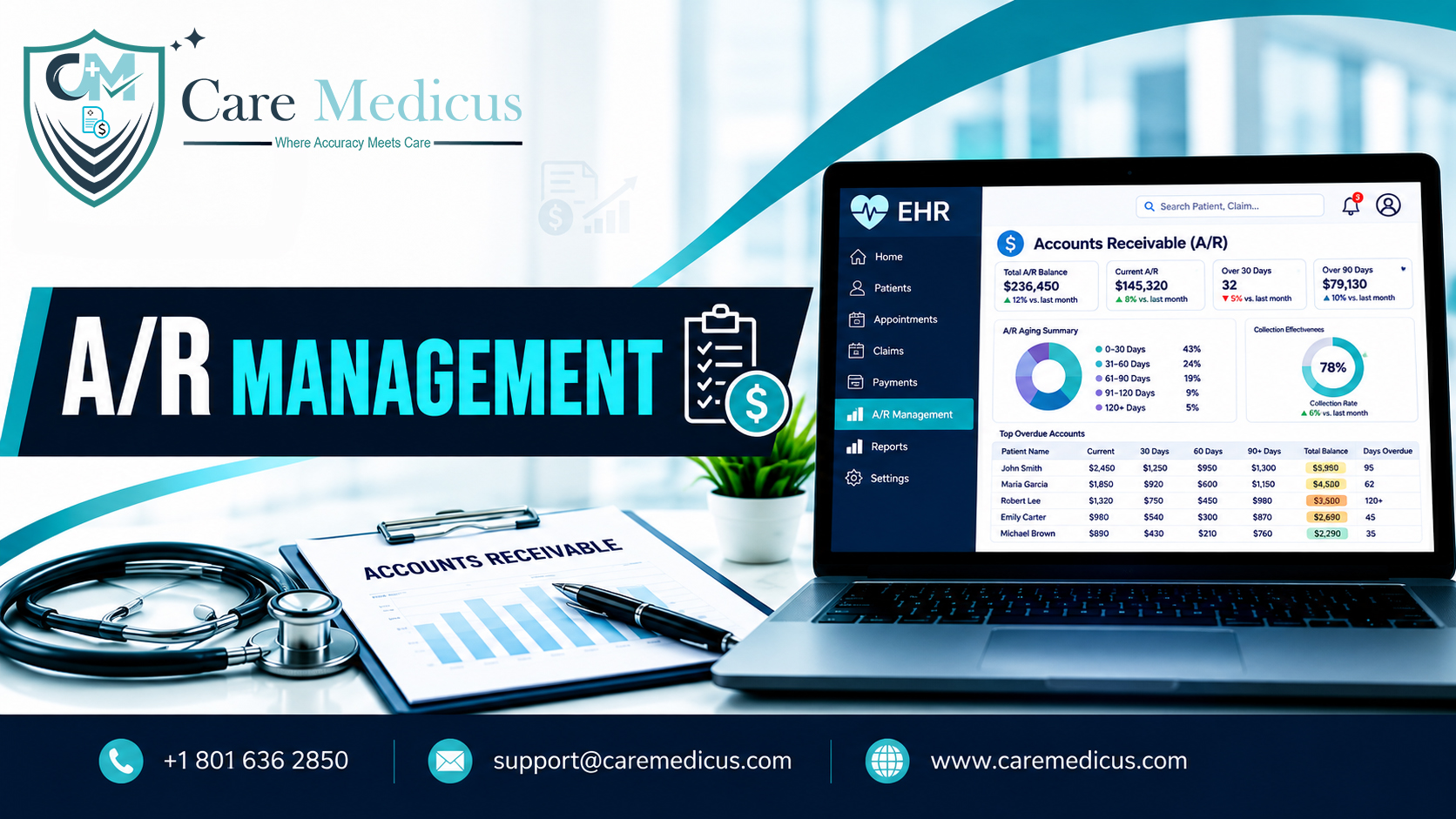
Unpaid and aging claims can quietly reduce your practice’s cash flow, create unnecessary administrative work, and make it harder to understand how much revenue is actually recoverable. Effective Accounts Receivable Management helps you identify outstanding balances, prioritize unresolved claims, follow up with insurance payers, investigate underpayments, and address issues before balances become increasingly difficult to collect.
Care Medicus LLC provides structured A/R management services for healthcare practices with more than 10 years of experience in medical billing and revenue cycle support. Our services focus on insurance follow-up, aging report review, underpayment recovery, balance resolution, and revenue recovery.
We review outstanding receivables using organized work queues, claim status information, payer portals, and revenue cycle technology where available. Depending on your existing workflow and system access, our team can support processes involving platforms such as R1 RCM, Waystar, AKASA, and BillingParadise ARAnalyzer.
Instead of allowing unresolved claims to sit untouched, we help your practice create a more consistent follow-up process. Claims can be prioritized by aging, balance amount, payer status, timely filing risk, and the underlying reason payment has not been received.
Whether you are dealing with increasing balances in the 61–90 or 91–120-day aging buckets, recurring payer delays, or possible underpayments, Care Medicus LLC helps bring structure to your receivables workflow.


Why Accounts Receivable Management Matters to Your Medical Practice
Accounts receivable represents money your practice has earned or expects to collect but has not yet received. In healthcare, those balances may be connected to insurance claims, patient responsibility, secondary insurance, payer adjustments, denied claims, underpayments, or claims that require additional documentation or follow-up.
A growing A/R balance does not always mean that the revenue is permanently lost. However, the longer a claim remains unresolved, the greater the risk that timely filing deadlines, documentation issues, payer policies, or collection limitations will reduce the opportunity for recovery. That is why consistent A/R management is an important part of healthcare revenue cycle management.
Care Medicus LLC helps practices review outstanding balances and determine where follow-up efforts may be needed. Our team can organize A/R work by aging categories such as 0–30 days, 31–60 days, 61–90 days, 91–120 days, and over 120 days. This allows your practice to see which balances may require immediate attention.
Our A/R management services focus on identifying the reason a claim remains unpaid rather than simply making repeated status calls. We review available claim information, payment records, Explanation of Benefits information, Electronic Remittance Advice details, denial reasons, and payer responses. Depending on your technology environment, workflows may involve Waystar, AKASA, payer portals, practice management systems, or other available revenue cycle tools. The objective is straightforward: help you maintain visibility into outstanding receivables, address unresolved balances systematically, and reduce avoidable revenue leakage.
Common Problems Increasing Your A/R And How We Reduce It
Unpaid Insurance Claims Receive Inconsistent Follow-Up
One of the most common reasons A/R grows is inconsistent insurance follow-up. Claims may initially appear clean but remain unpaid because of payer processing delays, missing information, coordination of benefits issues, eligibility discrepancies, authorization requirements, or payer requests that were never addressed. When staff members are managing scheduling, patient calls, billing, and other responsibilities at the same time, unpaid claims can easily remain in a work queue longer than intended. As balances move into older aging categories, the risk associated with timely filing limits and recovery effort can increase.
Care Medicus LLC creates a more organized insurance follow-up workflow by reviewing outstanding claims according to aging, balance amount, payer status, and potential filing deadlines. Our team investigates available claim information through payer portals, practice management systems, and revenue cycle platforms such as Waystar or other systems available to your practice. We document follow-up activity, identify outstanding payer requirements, and prioritize claims that require timely attention. Rather than waiting until claims reach 90 or 120 days, our workflow can support regular review cycles, including weekly or monthly A/R prioritization based on your practice’s needs.
Aging Reports Show Increasing Balances Without Clear Priorities
An A/R aging report can contain hundreds or thousands of outstanding balances, making it difficult for a small practice to determine where to begin. Without structured review, staff may spend time on low-value balances while larger claims, timely filing risks, and recurring payer issues continue to age. A high total A/R balance also does not reveal the underlying cause. Some claims may be pending normally, while others may involve denials, underpayments, missing documentation, or payer processing errors. Without root cause analysis, the same issues can continue generating new receivables.
Care Medicus LLC reviews aging reports by separating balances into meaningful categories and identifying where follow-up can have the greatest operational value. We can analyze 0–30, 31–60, 61–90, 91–120, and over 120-day balances, along with payer patterns and high-dollar claims. Revenue cycle analytics and available tools such as BillingParadise ARAnalyzer may support this analysis where applicable. We focus on identifying recurring issues so your practice can address both existing A/R and process problems contributing to future balances. Review frequency can be structured weekly, biweekly, or monthly based on claim volume.
Insurance Underpayments Go Undetected
A claim may receive a payment and disappear from the follow-up queue even when the reimbursement amount is lower than expected. Underpayments can occur because of fee schedule discrepancies, contract interpretation issues, incorrect payment calculations, coding or modifier issues, payer processing errors, or missing information. If payments are posted without comparing the allowed amount or expected reimbursement where appropriate, your practice may close an account without investigating whether additional revenue could be recoverable. Over time, even relatively small payment variances can create cumulative revenue leakage.
Care Medicus LLC helps review potential payment variances by comparing available payment information, EOBs, ERAs, claim details, and applicable reimbursement expectations. Our team identifies accounts that may warrant additional review and supports the appropriate follow-up, reconsideration, corrected claim, or appeal process when justified. Available revenue cycle platforms, analytics, and payer portals can support this workflow, including systems such as R1 RCM or your existing billing environment. We prioritize actionable balances and document follow-up activity. The timeline depends on payer response and the nature of the discrepancy, but early identification helps prevent avoidable aging.
Unresolved Patient and Insurance Balances Continue to Age
Not every outstanding balance is caused by an unpaid insurance claim. Some balances remain open because patient responsibility was calculated incorrectly, secondary insurance was not processed, payments were posted incorrectly, or an account was left unresolved after a payer adjustment. Without a clear balance resolution process, these accounts can remain on the books for months. Older balances become increasingly difficult to investigate because documentation, payer response windows, and collection opportunities may become more limited. Unresolved balances can also distort your practice’s financial reporting.
Care Medicus LLC reviews unresolved balances to determine the appropriate next step based on available account and claim information. We investigate whether a balance relates to insurance, secondary coverage, patient responsibility, payment posting, contractual adjustments, or another identifiable issue. Our team can use available practice management tools, payer portals, automation workflows, and revenue cycle technology such as AKASA where relevant to the existing workflow. We help prioritize accounts by age and recovery potential, with regular work queue reviews designed to keep actionable balances from being repeatedly overlooked.
Our Accounts Receivable Management Services
Insurance Follow-Up
Insurance follow-up is one of the most important components of effective accounts receivable management. Submitting a claim does not always mean the claim will move through the payer’s system without additional attention. Claims may remain pending because of processing delays, missing information, coordination of benefits issues, eligibility questions, prior authorization requirements, medical necessity concerns, or requests for documentation.
Care Medicus LLC provides structured insurance follow-up to help your practice investigate unpaid and unresolved claims.
Our team reviews available claim status information and determines the appropriate next action. Depending on the payer and your technology environment, this may involve reviewing payer portals, Electronic Remittance Advice information, claim history, clearinghouse data, or internal billing records.
We do not simply repeat generic status inquiries. We work to identify why the claim remains outstanding and what information or action may be required.
Insurance follow-up can include:
- Claim status review
- Payer communication
- Documentation follow-up
- Corrected claim coordination
- Denial follow-up
- Reconsideration support
- Appeal support when appropriate
- Secondary insurance follow-up
- Timely filing monitoring
- Outstanding payer request tracking
We recommend regular A/R follow-up cycles instead of allowing unpaid claims to accumulate until they become an emergency. High-risk claims can be prioritized sooner based on aging, dollar amount, payer deadlines, and claim status.
Aging Report Review
An aging report provides a snapshot of outstanding receivables based on the amount of time a balance has remained unpaid. However, reviewing the report is only useful when your practice has a process for deciding which accounts require action.
Care Medicus LLC reviews A/R aging reports to help identify trends, priorities, and unresolved issues.
We can organize receivables into common aging categories, including:
- 0–30 days
- 31–60 days
- 61–90 days
- 91–120 days
- Over 120 days
The purpose is not simply to reduce the total number displayed on the report. We analyze the available information to identify why balances are aging. For example, a large concentration of claims with one payer may indicate a recurring processing issue. A group of claims with similar denial reasons may suggest a registration, authorization, coding, or documentation problem. A significant number of underpayments may require reimbursement review.
We can structure aging report reviews around your claim volume and internal workflow, including weekly, biweekly, or monthly review schedules. The goal is to help you make decisions based on actionable data rather than allowing your A/R report to become a list of balances that no one has time to investigate.
Underpayment Recovery
Receiving a payment does not always mean a claim has been fully resolved. An underpayment occurs when the amount paid appears to be lower than the amount expected under the applicable payer arrangement, benefit, fee schedule, or claim circumstances. However, not every payment difference is automatically an error. Contractual adjustments, patient responsibility, coverage limitations, bundling rules, coding requirements, and payer policies can affect reimbursement. Care Medicus LLC helps your practice review potential underpayments and determine whether additional investigation is appropriate.
Our process may include reviewing:
- EOBs
- ERAs
- Allowed amounts
- Payment details
- Claim information
- Contractual information available to the practice
- Adjustment codes
- Payment variances
- Payer correspondence
When an account appears to require action, we support the appropriate follow-up process based on the payer’s available procedures. This may involve a reconsideration request, corrected claim, appeal, or additional documentation. Our team can prioritize higher-value and recurring payment variances first so your staff does not spend excessive time investigating accounts with limited recovery potential.
We do not guarantee recovery because the outcome depends on payer rules, claim circumstances, documentation, and applicable contracts. However, identifying potential underpayments early gives your practice the opportunity to investigate before relevant deadlines pass.
Balance Resolution
Outstanding balances can become difficult to manage when their source is unclear. An account may contain an unpaid insurance balance, a secondary insurance issue, patient responsibility, a posting discrepancy, a contractual adjustment, or an unresolved claim status. Treating every outstanding balance the same can lead to wasted effort and unnecessary aging. Care Medicus LLC provides balance resolution support by reviewing available account information and identifying the most appropriate next step.
Our process can include:
- Reviewing account balances
- Checking insurance claim status
- Identifying secondary coverage
- Reviewing payment posting
- Investigating adjustment activity
- Confirming available patient responsibility
- Identifying unresolved payer actions
- Prioritizing balances by age and value
Depending on the practice’s technology environment, this work may involve payer portals, practice management systems, clearinghouses, and automation or analytics platforms. Our objective is to create a clearer path for each unresolved balance rather than allowing accounts to remain indefinitely in an aging report. Regular review cycles help ensure actionable balances continue moving through the appropriate workflow.
Revenue Recovery
Revenue recovery focuses on identifying outstanding or incorrectly resolved accounts that may still have a legitimate opportunity for follow-up. Healthcare practices can experience revenue leakage for many reasons. A denied claim may not have been appealed. An underpayment may have been posted without review. A corrected claim may never have been submitted. Secondary insurance may not have been billed. A payer request for documentation may have gone unanswered. Care Medicus LLC helps review these situations and prioritize accounts based on age, balance, available documentation, payer requirements, and recovery potential. Our revenue recovery workflow is designed to complement insurance follow-up, aging analysis, underpayment review, and balance resolution. We examine available account information to determine whether further action may be appropriate.
The process may involve:
- Claim status investigation
- Payer follow-up
- Underpayment analysis
- Denial review
- Corrected claim coordination
- Reconsideration support
- Appeal coordination when appropriate
- Secondary claim follow-up
- Documentation tracking
We do not describe every outstanding balance as recoverable. Some accounts may be subject to payer deadlines, contractual adjustments, coverage limitations, or other factors that limit recovery. Our focus is on helping your practice identify actionable opportunities before they are overlooked. With more than 10 years of experience supporting healthcare revenue cycle workflows, Care Medicus LLC provides additional administrative capacity when your internal team needs help managing unresolved receivables.
How Our A/R Management Process Works
Step 1: Review Your Outstanding Receivables
The process begins with a review of available A/R data, including aging reports, outstanding claims, payer balances, unresolved denials, and payment information. We examine the age and value of balances to understand where the most significant follow-up opportunities may exist. A practice with a high percentage of receivables over 90 days may require a different strategy than a practice with mostly recent claims awaiting normal payer processing.
Step 2: Segment Accounts by Priority
We organize accounts based on relevant factors such as:
- Aging category
- Balance amount
- Payer
- Claim status
- Denial reason
- Timely filing risk
- Documentation requirements
- Potential underpayment
- Recovery opportunity
This helps create a more structured work queue.
Step 3: Investigate the Root Cause
We review available account and claim information to identify why payment has not been received or why a balance remains unresolved. The issue may involve the payer, documentation, eligibility, authorization, coding, payment posting, or another administrative factor.
Step 4: Take Appropriate Follow-Up Action
Based on the available information, our team may coordinate claim follow-up, corrected claim activity, documentation submission, reconsideration, appeal support, or other appropriate administrative action.
Step 5: Document and Track Activity
A/R management requires continuity. Follow-up should not depend on one staff member remembering what happened during the last payer call. We maintain organized workflow documentation based on your systems and processes.
Step 6: Review Trends and Recurring Problems
The final objective is not only to resolve individual balances. We also look for patterns that may contribute to future A/R. If one issue repeatedly creates unpaid claims, addressing the source may help reduce the volume of similar receivables over time.
A/R Management Technology and Workflow Support
Care Medicus LLC can work within your existing revenue cycle environment rather than requiring a complete technology change. Depending on your systems, available access, and workflow requirements, A/R management may involve platforms and technologies such as R1 RCM, Waystar, AKASA, and BillingParadise ARAnalyzer. These technologies can support different aspects of the revenue cycle, including claims management, automation, analytics, and receivables workflows.
The exact functionality available depends on the product, configuration, organization, and permissions. Our approach combines available technology with structured human review. Automation can help organize large volumes of information, but unresolved claims often require context. A payer response may need interpretation. An underpayment may require comparison with available reimbursement information. A denial may require investigation before the next action can be determined. For this reason, Care Medicus LLC focuses on using technology to support workflow efficiency while maintaining administrative oversight.
We can also work with:
- Practice management systems
- Electronic health record systems
- Payer portals
- Clearinghouses
- Claim status tools
- A/R dashboards
- Aging reports
- Work queues
- EOB and ERA data
The objective is to fit A/R management into your existing revenue cycle process and improve visibility into unresolved balances.
Why High A/R Can Affect Your Practice’s Cash Flow
High accounts receivable can create financial uncertainty even when your practice is clinically busy. A large number of patient encounters does not automatically translate into collected revenue. Claims must move through the billing process, payers must process them, payments must be posted accurately, and unresolved balances must receive appropriate follow-up. When these processes become disconnected, outstanding balances can accumulate.
Older A/R can affect your practice by:
- Delaying cash flow
- Increasing administrative workload
- Making financial forecasting more difficult
- Increasing the risk of missed filing deadlines
- Creating additional payer follow-up
- Hiding underpayment opportunities
- Increasing revenue leakage
- Making account reconciliation more complex
Care Medicus LLC helps bring greater structure to this process through insurance follow-up, aging report review, underpayment recovery, balance resolution, and revenue recovery. We prioritize action based on available account information instead of treating every outstanding balance as equally urgent. For example, a recently submitted claim may require normal processing time, while a high-dollar balance approaching a timely filing deadline may require immediate investigation. This prioritization can help your practice use administrative resources more effectively. We do not promise that every outstanding claim will be recovered. Payer rules, documentation, coverage, contracts, filing deadlines, and claim circumstances all affect the final outcome. However, a structured A/R process can help ensure that actionable accounts receive attention before opportunities become more limited.
Why Small Practices Outsource Accounts Receivable Management
Small medical practices often have limited administrative resources. A practice manager may be responsible for billing oversight, scheduling, staffing, payer communication, patient concerns, reporting, and daily operations. Adding detailed insurance follow-up and aging analysis to those responsibilities can become difficult. A/R management is also ongoing. New claims enter the system while older claims require follow-up. If staff falls behind for several weeks, the outstanding workload can grow quickly. Outsourcing A/R management can provide additional administrative support without requiring your practice to assign every follow-up responsibility to internal staff.
Care Medicus LLC provides A/R management services focused on:
- Insurance follow-up
- Aging report review
- Underpayment recovery
- Balance resolution
- Revenue recovery
- Outstanding claim analysis
- Denial follow-up
- Claim prioritization
- Payer communication support
- A/R trend analysis
With more than 10 years of healthcare and medical billing experience, our team can support your existing workflow and available technology. Outsourcing does not mean losing visibility into your receivables. A structured A/R process can provide clearer reporting and better awareness of which balances are being reviewed. The appropriate outsourcing arrangement depends on your claim volume, staffing capacity, current A/R, technology environment, and internal revenue cycle goals. If your team regularly postpones insurance follow-up because daily operations take priority, additional A/R support may help prevent balances from continuing to age.
Frequently Asked Questions
What Is Accounts Receivable Management in Medical Billing?
Accounts receivable management in medical billing is the process of monitoring, analyzing, and following up on money owed to a healthcare practice. These balances may involve insurance claims, patient responsibility, secondary insurance, underpayments, denied claims, or unresolved payment issues. A/R management generally includes reviewing aging reports, investigating unpaid claims, following up with insurance payers, resolving outstanding balances, and identifying potential revenue recovery opportunities.
Care Medicus LLC provides A/R management support through five primary services:
- Insurance Follow-Up
- Aging Report Review
- Underpayment Recovery
- Balance Resolution
- Revenue Recovery
The purpose is to help your practice understand why balances remain outstanding and determine whether further action may be appropriate. A/R management is not simply a collection activity. In healthcare revenue cycle management, the process often involves reviewing claim status, payer responses, EOBs, ERAs, denial information, payment records, and applicable payer requirements. Regular review is important because older balances can become more difficult to address.
What Is Aging in Accounts Receivable?
Aging refers to the amount of time an account or claim has remained unpaid. Healthcare practices commonly organize outstanding balances into aging categories such as:
- 0–30 days
- 31–60 days
- 61–90 days
- 91–120 days
- Over 120 days
The purpose of an aging report is to help identify how much money remains outstanding and how long those balances have been unresolved. Older balances often deserve closer review because filing deadlines, documentation availability, and payer response opportunities may become more limited over time. However, aging alone does not explain why a claim remains unpaid. Care Medicus LLC reviews aging reports to identify underlying issues, such as recurring payer delays, denials, underpayments, missing documentation, or unresolved claim status. We then help prioritize accounts based on factors including age, balance amount, payer, and available recovery opportunities. The goal is to create an actionable work queue rather than simply reviewing a list of outstanding balances.
How Do You Reduce A/R in Revenue Cycle Management?
Reducing A/R requires both consistent follow-up on existing balances and improvements to the processes that create future receivables. Care Medicus LLC approaches A/R reduction through several steps. First, we review aging reports and prioritize balances according to age, value, payer status, and timely filing risk.
Second, we investigate why claims remain unpaid. Third, we support the appropriate next action, which may involve insurance follow-up, documentation submission, corrected claims, reconsideration, appeals, or balance resolution. Finally, we look for recurring patterns.
For example, if the same payer repeatedly delays claims because of a missing data element, the practice may need to address that issue earlier in the revenue cycle. A/R reduction should not be measured only by writing off old balances. A meaningful strategy focuses on resolving actionable accounts and reducing the causes of avoidable receivables.
Care Medicus LLC can structure follow-up cycles around your practice’s workload, including regular weekly, biweekly, or monthly reviews.
What Causes High Accounts Receivable in a Medical Practice?
High A/R can result from many different issues.
Common causes include:
- Delayed insurance follow-up
- Claim denials
- Missing documentation
- Eligibility problems
- Authorization issues
- Coding errors
- Payment posting problems
- Underpayments
- Coordination of benefits issues
- Delayed corrected claims
- Missed payer requests
- Unresolved patient responsibility
- Inconsistent aging report review
Sometimes the problem is not one major failure but a combination of smaller issues. For example, a practice may submit claims correctly but lack sufficient staff time for consistent follow-up when a payer delays payment. Over several months, those balances can move into older aging categories. Care Medicus LLC reviews available A/R data to identify patterns and prioritize the underlying causes of outstanding balances. Our services combine insurance follow-up, aging analysis, underpayment review, balance resolution, and revenue recovery. We focus on actionable information rather than assuming every balance has the same cause.
How Often Should an A/R Aging Report Be Reviewed?
The ideal review frequency depends on your practice’s claim volume, payer mix, staffing resources, and current A/R performance. Many practices benefit from reviewing A/R on a regular schedule rather than waiting until balances become significantly aged. For higher-volume practices, weekly review may help identify urgent accounts earlier. Other organizations may use biweekly or monthly review cycles. Care Medicus LLC can support a review schedule based on your operational needs.
During the review, we can prioritize:
- High-dollar balances
- Claims approaching payer deadlines
- Accounts over 60 or 90 days
- Recurring payer issues
- Potential underpayments
- Unresolved denials
- Claims requiring documentation
The most important factor is consistency. A monthly report is less useful if no one has the capacity to act on the information. Our A/R management services are designed to support ongoing follow-up rather than one-time cleanup projects.
How Do You Follow Up on Unpaid Insurance Claims?
Following up on an unpaid insurance claim begins with understanding its current status. Our team reviews available information through payer portals, practice management systems, clearinghouses, claim history, EOBs, and ERAs. We determine whether the claim is pending, denied, rejected, missing information, or requires another action. The appropriate next step depends on the reason the claim remains unpaid.
Possible actions can include:
- Submitting requested documentation
- Correcting claim information
- Coordinating a corrected claim
- Checking coordination of benefits
- Reviewing authorization requirements
- Requesting reconsideration
- Supporting an appeal
- Monitoring a pending payer action
Care Medicus LLC documents follow-up activity and helps maintain visibility into outstanding requirements. We prioritize claims based on aging, balance amount, filing risk, and available information. Payer processing times remain outside our control, so we do not guarantee a specific payment date. However, consistent follow-up helps reduce the risk that actionable claims remain untouched.
How Can a Medical Practice Recover Insurance Underpayments?
The first step is identifying whether a payment may actually be lower than expected. Care Medicus LLC reviews available EOBs, ERAs, payment information, claim details, adjustment codes, and applicable reimbursement expectations. Not every payment difference represents an error. Coverage limitations, patient responsibility, contractual adjustments, bundling rules, and payer policies can affect the final amount. When an underpayment appears to warrant further review, the next step may involve payer follow-up, a reconsideration request, a corrected claim, or another available process.
We prioritize potential underpayments based on balance amount, recurring payer patterns, and available recovery opportunities. The outcome depends on the claim, payer, documentation, and applicable reimbursement requirements. We do not guarantee recovery. However, reviewing payment variances before deadlines pass can help your practice identify opportunities that might otherwise be overlooked.
What Happens When Claims Remain Unpaid for More Than 90 Days?
A claim over 90 days old is not automatically unrecoverable, but it generally deserves closer attention. The longer a balance remains unresolved, the more important it becomes to understand why payment has not been received. The account may still be pending, require documentation, involve a denial, have a coordination of benefits issue, or require a corrected claim. Some claims may also be approaching payer-specific deadlines. Care Medicus LLC reviews older A/R to identify the current status and determine whether additional follow-up is appropriate.
We prioritize accounts based on age, balance, payer requirements, available documentation, and recovery potential. Accounts over 90 or 120 days may require a different workflow than recent claims because the risk associated with filing limits and unresolved documentation can increase. Our objective is to investigate actionable balances rather than automatically writing them off.
What Is Balance Resolution in Medical Billing?
Balance resolution is the process of investigating an outstanding account and determining the appropriate next step. A balance may be connected to unpaid insurance, secondary coverage, patient responsibility, incorrect payment posting, contractual adjustments, or another unresolved issue. Care Medicus LLC reviews available account information to identify the source of the balance. Once the issue is identified, the appropriate action may involve insurance follow-up, payment correction, secondary billing, documentation review, or another administrative process. The goal is to move the account toward a clear resolution instead of allowing it to remain indefinitely on the aging report. Balance resolution is especially important when practices have large numbers of accounts with unclear status. A structured process can help separate balances that require insurance action from those requiring internal review or patient responsibility confirmation.
When Should a Practice Outsource Accounts Receivable Management?
A practice may consider outsourcing A/R management when internal staff does not have enough capacity to consistently review aging reports and follow up on outstanding balances.
Common signs include:
- A growing percentage of A/R over 90 days
- Inconsistent insurance follow-up
- Large volumes of unresolved claims
- Limited internal billing staff
- Frequent underpayment concerns
- Lack of time for aging analysis
- Recurring payer issues
- Difficulty tracking follow-up activity
Outsourcing can provide additional administrative support while allowing your internal team to focus on patient operations and other priorities. Care Medicus LLC offers more than 10 years of experience in healthcare and medical billing support. Our services focus on insurance follow-up, aging report review, underpayment recovery, balance resolution, and revenue recovery. The right approach depends on your practice’s claim volume, payer mix, current A/R, technology environment, and internal resources.
Take Control of Your Outstanding Accounts Receivable
Outstanding receivables require consistent attention. Waiting until balances become significantly aged can limit your options and create additional pressure on your internal team. Care Medicus LLC helps healthcare practices create a more structured approach to Accounts Receivable Management.
Our services include:
- Insurance Follow-Up
- Aging Report Review
- Underpayment Recovery
- Balance Resolution
- Revenue Recovery
- Outstanding Claim Analysis
- Denial Follow-Up
- Payer Communication Support
- A/R Prioritization
- Revenue Cycle Trend Analysis
With more than 10 years of experience, we support medical practices that need additional resources for managing unpaid and unresolved balances. Our team can work within available practice management systems, payer portals, and revenue cycle technology, depending on your organization’s systems and access. You do not have to wait until your A/R reaches an unmanageable level. A regular review process can help identify actionable balances, recurring issues, and potential revenue recovery opportunities earlier.