



It is a scene familiar to almost every patient and provider. The doctor enters the exam room, greets the patient, and almost immediately turns their back to type into a laptop. The rhythm of the visit is set not by the conversation, but by the “click-clack” of the keyboard. Eye contact is replaced by screen time, and the human connection—the very foundation of healing—takes a backseat to data entry.
This isn’t a choice physicians make willingly. It is a survival mechanism. After the clinic closes, thousands of providers engage in what is grimly known as “pajama time.” These are the unpaid hours spent late at night finishing charts, responding to messages, and navigating the labyrinth of the Electronic Health Record (EHR). Research suggests that for every hour physicians spend with patients, they spend nearly two hours on administrative tasks.
This imbalance has consequences. It drives record-high burnout rates, reduces patient satisfaction, and limits the number of people a practice can serve.
However, a solution has emerged that promises to dismantle this administrative barrier. It is called the “Invisible Scribe”—technology that doesn’t just record, but listens, understands, and structures clinical data.
This article explores the real Return on Investment (ROI) of Ambient Clinical Intelligence (ACI). We will look beyond simple time-savings to discuss how this technology impacts clinical accuracy, financial throughput, and perhaps most importantly, the restoration of the provider-patient relationship.
What Exactly is an “Invisible Scribe”?
To understand the value, we must first define the tool. Ambient Clinical Intelligence is not a simple voice recorder. It utilizes advanced Natural Language Processing (NLP) and generative AI to interpret conversations in real-time.
Unlike legacy dictation software, which requires a quiet room and specific voice commands (“period,” “new paragraph”), an AI Scribe works in the background of a chaotic, natural environment. It distinguishes between the provider and the patient, filters out pleasantries about the weather or local sports teams, and extracts medically relevant information to construct a structured clinical note.
The “Zero-Click” Workflow
The user experience is designed to be as unobtrusive as possible, often referred to as a “zero-click” or low-touch workflow:
- Initiation: The provider opens a mobile or desktop app at the start of the visit.
- The Conversation: The provider engages naturally with the patient. There is no need to slow down or speak like a robot. The phone simply sits on the desk, listening.
- Processing: The AI scribe engine analyzes the audio stream. It identifies the Chief Complaint, History of Present Illness (HPI), and Assessment/Plan.
- Generation: Within seconds of the visit ending, a structured SOAP note is generated and ready for review.
The Distinction: AI vs. Legacy Solutions
It is crucial to differentiate ACI from previous documentation methods.
Vs. Dictation: Dictation is a retrospective task. The doctor sees the patient, remembers the details, and then dictates them later. This doubles the work. ACI captures the note during the visit, requiring only a review afterward.
Vs. Human Remote Scribes: While human scribes are effective, they are expensive and hard to scale. A human scribe typically costs a practice around $2,800 per month and works limited hours. In contrast, an AI scribe solution is available 24/7, never calls in sick, and costs a fraction of the price—often hovering around $100 to $200 per month.
Core Benefits: Why Practices Are Switching
The adoption of ACI is not just about cool technology; it is about survival in a high-pressure healthcare environment. Practices are switching because the benefits address the three biggest pain points in modern medicine: time, accuracy, and connection.
Unlocking EHR Efficiency
The primary driver for adoption is the desperate need for EHR efficiency. The “clerical burden” of documentation is the number one cause of physician dissatisfaction.
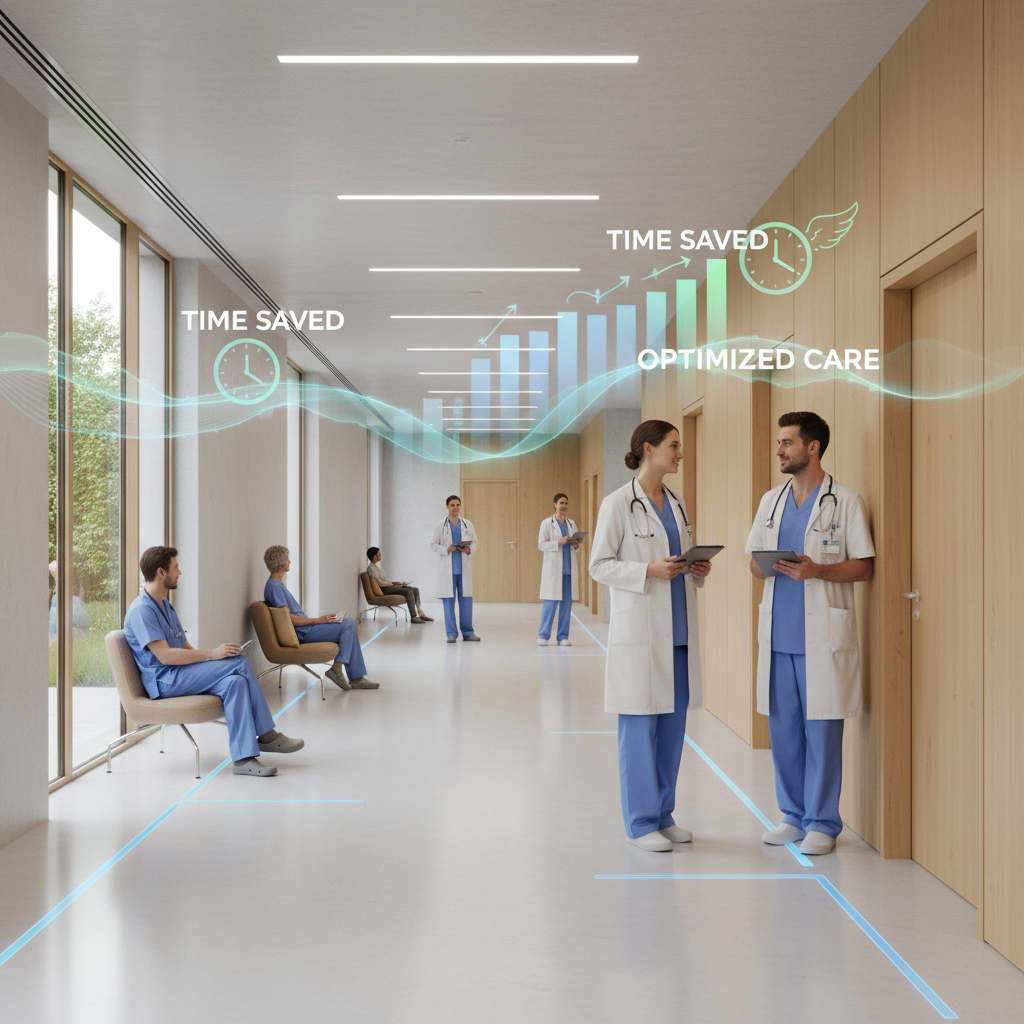
By implementing an AI scribe, practices report reducing documentation time by 20% to 40%. For a full-time provider, this translates to saving up to two hours per day. That is two hours reclaimed for family, rest, or professional development. In some specific use cases, such as routine follow-up appointments, efficiency gains can be as high as 90%, essentially automating the entire documentation process aside from a quick final review.
Clinical Accuracy & Completeness
Human memory is fallible. When a provider documents a visit four hours after it happened, nuances are lost. A patient might mention a subtle symptom early in the interview that doesn’t seem relevant until later. If the provider relies on memory during “pajama time,” that detail might vanish.
ACI captures details in the moment. It provides a transcript and a summary that acts as a perfect memory aid. Because the AI is trained on vast datasets of medical terminology, it captures complex histories with a level of granularity that tired human brains might miss at 9:00 PM.
The “Human” Element
Paradoxically, bringing a robot into the exam room allows the doctor to be more human.
When a provider stares at a screen, they miss non-verbal cues. They might miss the patient wincing when they mention a specific movement, or the look of confusion when a medication is explained. By removing the screen barrier, providers can return to active listening. They can look their patients in the eye. This builds trust, improves diagnostic accuracy, and reminds both parties why they are in the room in the first place.

Read More >> Natural Language Processing (NLP) in EHR Documentation: How the ‘Invisible Scribe’ Works
The ROI: Redefining the “Efficiency” Metric
When evaluating an investment in technology, healthcare leaders look at the Return on Investment. With Ambient Clinical Intelligence, the ROI is twofold: quantitative financial gains and qualitative “soft” metrics.
Quantitative Gains (The Hard Numbers)
The financial argument for ACI is straightforward and compelling.
- Throughput: If a provider saves 5-10 minutes per visit on documentation, they can realistically see one or two additional patients per day without adding stress or working longer hours. In a fee-for-service model, this directly increases clinic revenue, often paying for the software subscription in a single day.
- Cost Reduction: For practices currently employing human scribes, switching to AI offers immediate, massive overhead reduction. Eliminating transcription costs further sweetens the deal.
- Faster Billing: Cash flow is king. When notes are completed immediately after the visit, they can be coded and billed the same day. This reduces the “lag time” in the revenue cycle and ensures the practice gets paid faster.
Qualitative Gains (The Soft Metrics)
While harder to put on a spreadsheet, the soft metrics are arguably more valuable for long-term practice health.
- Cognitive Load: Multitasking is a myth; the brain simply switches tasks rapidly, which is exhausting. Listening, typing, analyzing, and diagnosing simultaneously creates immense cognitive load. ACI provides “cognitive freedom,” allowing the physician to focus solely on the patient. This reduces decision fatigue and medical errors.
- Retention: Burnout is a massive financial risk. Replacing a physician can cost a health system hundreds of thousands of dollars in recruitment fees and lost revenue. Tools that reduce burnout are essential retention strategies. Happy doctors stay at the practice longer.
- Patient Satisfaction: Patients know when they are being listened to. When a doctor is present and attentive, patient satisfaction scores rise. This leads to better adherence to treatment plans and stronger patient loyalty.
Read More >> How AI Medical Assistants Are Transforming Healthcare Workflows in 2025 (While Staying HIPAA-Compliant)
Addressing the Hurdles: Trust and Tech
Despite the clear benefits, integrating AI into a clinical workflow requires caution. Trust must be earned, and safety is paramount.
Privacy & Security
Privacy is the elephant in the room. Healthcare leaders must ensure any ACI platform is SOC 2 Type 2 certified and fully HIPAA compliant.
Leading platforms utilize “data ephemeralization.” This means that once the audio is processed and the note is generated, the recording is permanently deleted. The audio isn’t stored indefinitely, reducing the risk of data breaches. Furthermore, providers should look for transparency regarding how data is used—specifically ensuring that patient data isn’t being used to train public AI models in a way that could compromise anonymity.
Integration Challenges
There is a difference between a standalone app and a deep integration. Many current solutions rely on a “copy-paste” workflow, where the doctor copies the generated note and pastes it into the EHR.
While simple, this carries risk. If a provider is tired, they might paste the note into the wrong patient’s chart. Practices must establish strict verification workflows—triple-checking patient names and dates of birth—before finalizing documentation. As the technology matures, direct EHR integrations will become the standard, mitigating this risk.
The Human “Editor-in-Chief”
It cannot be overstated: AI is a tool, not a replacement for clinical judgment. AI models can “hallucinate,” inventing details or misinterpreting a negation (e.g., hearing “patient has no chest pain” as “patient has chest pain”).
The provider must act as the Editor-in-Chief. The liability and the final sign-off remain with the human clinician. ACI generates a draft, but the physician provides the stamp of approval. Treating the AI output as a final product without review is a malpractice risk.

The Future of the Invisible Scribe
We are currently in the early stages of Ambient Clinical Intelligence. The technology is evolving rapidly, moving from passive documentation to active assistance.
Predictive Analytics
Soon, AI scribe tools will do more than just write. They will listen to the history and nudge providers regarding care gaps. If a patient mentions a family history of diabetes, the AI might flag that the patient is due for an A1C check. It could suggest potential diagnoses based on the constellation of symptoms mentioned, acting as a second set of eyes for the clinician.
Multimodal Capabilities
The next frontier is multimodal AI. Imagine a system that doesn’t just listen but also “sees” via a camera sensor (with consent). It could analyze a patient’s gait to track the progression of Parkinson’s disease or monitor physical tremors during the exam, adding these objective physical exam findings directly to the note.
Ambient Hospitals
While currently popular in outpatient clinics, the technology is moving into hospitals. Ambient listening devices in patient rooms could automate nursing documentation, capture shift handovers, and ensure that critical information isn’t lost during the chaotic transfer of care between departments.
Read More >> AI and Predictive Analytics in Healthcare to Reduce Claim Denials
Reclaiming the Art of Medicine
For decades, healthcare technology has too often stood between clinicians and their patients, demanding attention and contributing to fatigue rather than enabling care. That dynamic is changing. At Care Medicus, we see a future where technology fades into the background—supporting clinicians quietly, intelligently, and without disruption to the human connection that defines great medicine.
Ambient Clinical Intelligence represents a return to how care was meant to be delivered: face-to-face, empathetic, and fully present. When documentation and administrative tasks are handled seamlessly in the background, physicians can focus on listening, thinking, and caring. The most effective technology is not the most visible—it is the kind that removes friction, restores time, and allows clinicians to practice at the top of their license.
For healthcare leaders and practitioners, the question is no longer whether to adopt this technology, but how quickly it can be implemented to make a meaningful difference. Piloting an AI scribe solution today is a decisive step toward reclaiming evenings, improving financial performance, and refocusing attention on what matters most—the patient in front of you.
With proven expertise in intelligent documentation and workflow integration, Care Medicus helps organizations take that step with confidence—bringing invisible technology into everyday practice and delivering visible improvements in clinician satisfaction, efficiency, and patient care.
Leave a Reply