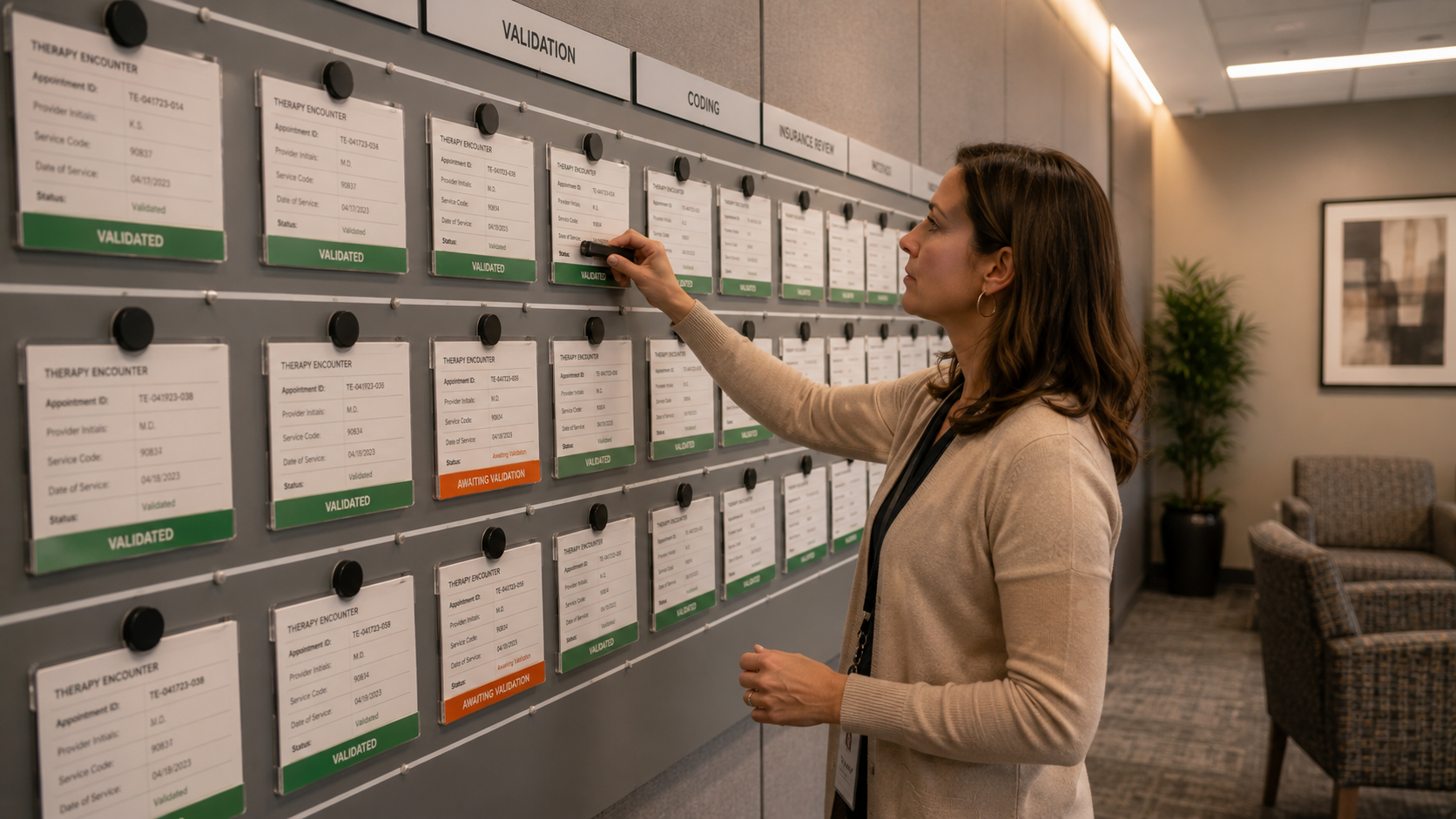
Mental health billing mistakes—including incorrect CPT coding, vague documentation, missed prior authorizations, and poor denial management—are the leading causes of claim denials in behavioral health. Denial rates in mental health billing run 85% higher than other medical specialties, making it critical for practices to identify and fix these errors before they compound into major revenue losses.
Mental health providers deliver care that genuinely changes lives. But here’s something that doesn’t get talked about enough: even the most skilled therapist or psychiatrist can watch thousands of dollars in earned revenue disappear every month—not because of anything clinical, but because of billing errors that are entirely preventable.
Behavioral health billing is notoriously complex. Denial rates for behavioral health services run approximately 85% higher than other medical specialties. That’s not a rounding error. That’s a systemic problem with real financial consequences—and it explains why so many practices find themselves in a constant cycle of rejected claims, resubmissions, and delayed payments that never seem to resolve.
What makes mental health billing particularly tricky is the combination of time-based CPT codes, payer-specific documentation requirements, telehealth policy changes, and ICD-10 diagnostic specificity—all layered on top of each other. Miss one detail, and a perfectly valid claim gets denied. Repeat that mistake across dozens of sessions, and you’re looking at a serious revenue leak.
This post breaks down the most critical mental health billing mistakes practices make—and more importantly, exactly how to fix them. Whether you’re a solo practitioner or managing a multi-provider behavioral health facility, these insights will help you submit cleaner claims, reduce denials, and protect the revenue your practice has already earned.
Foundational Mental Health Billing Mistakes in CPT and ICD-10 Coding
Coding is where most mental health billing mistakes begin. Unlike many medical specialties, behavioral health relies heavily on time-based CPT codes—meaning a 50-minute session and a 53-minute session are billed under entirely different codes, with different reimbursement rates. That precision requirement creates significant room for error.
Incorrect Time-Based CPT Code Selection
The individual psychotherapy codes most providers use daily—90832, 90834, and 90837—each correspond to specific session durations:
- 90832: 16–37 minutes of actual clinical contact
- 90834: 38–52 minutes
- 90837: 53 minutes or more
Here’s where the mistake happens: billing 90837 for a 50-minute session. That session belongs under 90834. Doing the reverse—billing 90832 for a 44-minute session—means underbilling. Both errors are common, and both are avoidable with one simple fix: document start and end times in every session note, and match the CPT code to actual session duration, not scheduled duration.
A 2025 update introduced CPT code 90868 for ultra-brief psychotherapy under 20 minutes. Providers who aren’t aware of this code are either underbilling or incorrectly applying 90832 to sessions that don’t meet its time threshold. Staying current on annual CPT updates—especially every January—is non-negotiable.
Repeatedly Using the Same ICD-10 Code Across Patients
This is a pattern auditors notice immediately. Billing the same ICD-10 diagnosis code—say, F41.9 (unspecified anxiety disorder)—across every patient in your practice is a red flag that can trigger a compliance review. Beyond the audit risk, it’s also clinically inaccurate.
ICD-10 specificity matters to payers. F32.0 (mild depressive episode, single occurrence) processes more cleanly than F32.9 (major depressive disorder, unspecified). The more specific your diagnosis code, the stronger your claim’s justification for medical necessity. Common behavioral health ICD-10 codes worth mastering include:
- F32.9 – Major depressive disorder, unspecified
- F41.1 – Generalized anxiety disorder
- F43.10 – Post-traumatic stress disorder, unspecified
- F90.2 – ADHD, combined presentation
- F10.20 – Alcohol use disorder, moderate
Every CPT code also needs a matching ICD-10 diagnosis that clearly explains why treatment is necessary. A mismatch between the procedure code and diagnosis code triggers denial code CO 11 (diagnosis inconsistent with procedure) or CO 167 (diagnosis not covered). Neither is recoverable without a resubmission.
Using Outdated Codes After Annual Updates
CPT and ICD-10 code sets are updated every year. Payers expect claims to use the current code set, and most have grace periods—but once those grace periods end, outdated codes result in automatic rejection. There’s no workaround.
Practices that don’t build annual code reviews into their workflow are essentially billing blind. Assign someone on your team to review CPT updates each January, update your billing software’s code library accordingly, and run a training session before the new codes go live.
Read More >> Top RCM Compliance Risks That Trigger Audits: A Complete Guide
Inadequate Patient Documentation and Its Impact on Mental Health Billing Accuracy
Documentation is the backbone of every successful claim. Payers don’t reimburse based on the care you provided—they reimburse based on what’s written down. Vague or incomplete notes are one of the most preventable causes of CO 50 (medical necessity) denials in behavioral health.
Failing to Establish Medical Necessity Through Clinical Notes
Insurance companies require that your documentation actively justifies why treatment is necessary. Phrases like “client reports doing better” or “supportive therapy provided” don’t establish medical necessity—they raise questions about it.
Strong clinical documentation for behavioral health claims should include:
- The patient’s presenting symptoms, linked to a DSM-5-TR diagnosis
- Observable functional impairments (not just subjective reports)
- Specific interventions used during that session—not general categories
- The patient’s response to those interventions
- Measurable progress toward documented treatment goals
- Start and end times for time-based codes
Services that are most commonly denied for insufficient documentation include 90837 (individual therapy, 60 minutes), 90791 (initial psychiatric evaluation), 90853 (group therapy), and H0010 (detoxification). These codes attract payer scrutiny precisely because they involve longer durations, higher reimbursement, or complex diagnostic criteria.
Adding objective assessment tools—like PHQ-9 scores for depression or GAD-7 scores for anxiety—to your session notes strengthens medical necessity arguments significantly. A partial hospitalization program that added ASAM dimension checklists and LOCUS scores to their progress notes in 2025 reported a measurable improvement in claim approval rates. That kind of documentation specificity is what separates reimbursed claims from denied ones.
Inconsistent Note Templates That Invite Audit Scrutiny
Auditors are trained to identify cloned notes—clinical documentation that looks identical across sessions or patients. Copy-pasting note templates without updating the clinical content doesn’t just weaken your claims; it creates compliance risk. Payers use analytics software that flags patterns of identical documentation.
The fix here is straightforward: standardize your note structure (SOAP and DAP templates are reliable frameworks), but ensure the clinical content within that structure is individualized to each session. Every note should reflect what specifically happened that day—not a generic description of what therapy usually looks like.
Require notes to be completed and signed within 24 hours of the session. Delayed documentation is both a billing risk and a liability risk. Practices that let notes accumulate for days before entry are leaving themselves exposed to denials based on timely filing windows that are already ticking.
Insurance Verification Failures and Prior Authorization Errors
Here’s a sobering fact: a single eligibility verification error at intake can result in an entire block of claims being denied mid-treatment. For long-term treatment episodes—residential programs, IOP, PHP—that can mean tens of thousands of dollars in lost revenue traced back to one missed check.
Incomplete or Infrequent Insurance Eligibility Verification
Verifying that a patient has insurance at intake is not the same as verifying that their insurance covers the specific services you’re providing. These are very different things. Behavioral health carve-outs to Managed Behavioral Health Organizations (MBHOs) are one of the most common sources of billing confusion—a patient’s general health plan may be with one insurer, but their mental health benefits are managed by a completely separate entity.
Before initiating treatment, verify:
- That the policy is currently active
- Which mental health benefits are covered, at what level of care
- Annual visit caps and session limits
- Copay and deductible obligations
- Whether behavioral health benefits are carved out to a separate MBHO
- Prior authorization requirements for the specific services you’re providing
Beyond the initial check, eligibility should be re-verified on a regular schedule—monthly for ongoing outpatient treatment, and at defined intervals (every 14 or 30 days) for residential, PHP, and IOP patients. Medicaid redeterminations in 2024 caused widespread CO 27 (expired coverage) and CO 31 (coverage gap) denials for patients whose eligibility lapsed mid-treatment. Regular sweeps catch these changes before they become denial patterns.
Skipping Prior Authorization for Services That Require It
Many insurance plans require prior authorization for extended therapy, higher levels of care, or specialized services. Skipping this step is one of the most expensive errors a behavioral health practice can make—because claims submitted without required authorization are denied outright, with little recourse.
Authorization errors generate specific denial codes: CO 151 (authorization expired), CO 50 (not medically necessary at this frequency), and CO 109 (service not covered at this level). Each of these signals a different process failure with a different fix.
Build a pre-service checklist into your intake workflow. Before the first session begins, confirm whether prior authorization is required, obtain the authorization number, record it in your billing system, and set calendar alerts 5–7 days before expiration. Some payers—Aetna and Cigna among them—required weekly reauthorization for residential treatment in 2024–2025. Assuming a single authorization covers an entire course of treatment is a costly assumption.
Read More >> Prior Authorization Pain Points: Overcoming Inefficiency with Integrated ePA Solutions
Telehealth Billing Mistakes That Trigger Mental Health Claim Denials
Telehealth has expanded dramatically since 2020, but the billing rules governing virtual behavioral health services remain one of the most variable—and most frequently misapplied—areas of mental health billing. Telehealth modifier errors consistently rank among the top reasons for claim denials in mental health practices.
Missing or Incorrect Telehealth Modifiers
The most common telehealth billing mistakes involve modifier misapplication. Here’s the essential breakdown:
- Modifier 95: Real-time audio/video telehealth (required by most commercial payers)
- Modifier 93: Audio-only phone sessions
- Modifier GT: Used for Medicare telehealth services (often alongside POS 02)
- FQ: Audio-only for Medicaid in some states
Using Modifier 95 and GT together on the same claim is incorrect and triggers denial code CO 4 (modifier invalid). Similarly, billing office Place of Service (POS 11) for a telehealth session instead of POS 02 (telehealth provided outside patient’s home) or POS 10 (telehealth provided in patient’s home) creates mismatches that result in rejection.
State-specific rules add another layer of complexity. Florida Medicaid requires the HE modifier on certain behavioral health services. California Medi-Cal uses U1 for peer support billing. Without payer-specific modifier matrices that are updated regularly, these differences become a constant source of preventable denials.
Missing Telehealth-Specific Documentation Requirements
Beyond modifiers, telehealth claims require documentation that in-person sessions don’t. Every telehealth note should specify the patient’s location at the time of service, the provider’s location, and the HIPAA-compliant platform used for the session. Some payers also require documentation confirming the patient’s consent to receive services via telehealth.
Telehealth coverage tightened after the COVID-19 public health emergency ended in 2023. Practices that built their telehealth billing processes during the PHE period and haven’t updated them since are operating with outdated assumptions. Review each payer’s current telehealth policies—not the policies from two years ago.
Claims Submission Errors and Ineffective Denial Management
Even when coding and documentation are accurate, claims can fail at the submission stage. And when denials do occur, the way a practice responds to them determines how much revenue is actually recovered.
Late Claim Submissions and Timely Filing Violations
Every payer sets strict filing deadlines—typically 90 to 180 days from the date of service, though some commercial plans allow as few as 30 days. A claim submitted outside this window receives an automatic CO 29 denial (timely filing exceeded), and these are rarely reversible without documented proof that the claim was submitted on time.
Behavioral health practices with documentation delays—where notes aren’t completed until days after service—are particularly vulnerable. If charges aren’t entered until notes are signed, and notes aren’t signed for 72 hours, you’ve already consumed three days of your filing window before the claim even exists in your system.
The fix is structured internal deadlines: clinical notes completed within 24 hours, charges entered within 48–72 hours, and claims submitted on a weekly schedule rather than monthly. Billing software with payer-specific deadline tracking removes the guesswork and creates accountability. According to industry estimates, up to 70% of CO 29 denials are recoverable if appealed quickly with proper proof of timely submission—but prevention is far less costly than appeals.
Improper Claim Resubmission and Duplicate Billing
When a claim is denied and a corrected version is submitted, the frequency code must indicate whether it’s a replacement claim (frequency code 7) or a void (frequency code 8). Submitting a corrected claim as a new claim without the appropriate frequency code triggers CO 18 (exact duplicate) or CO 97 (claim already adjudicated) denials. The payer sees two claims for the same service and rejects both.
Duplicate billing also occurs when two staff members inadvertently bill for the same session, or when system glitches create double entries during manual charge input. Beyond the immediate denial, duplicate billing patterns attract audit attention. Weekly internal claim reviews—before submission—catch these errors before they reach the payer.
Ignoring Denied Claims Rather Than Managing Them Systematically
Many practices treat denied claims as a dead end. They post the denial as an adjustment, write off the balance, and move on. This approach costs behavioral health providers a significant portion of recoverable revenue every year.
Most behavioral health claim denials are overturnable with the right appeal. CO 50 (medical necessity) denials, for example, can often be reversed by submitting additional clinical documentation—ASAM criteria, LOCUS/CALOCUS scores, objective assessment data—that wasn’t included in the original claim. A Texas-based SUD clinic reported reversing a substantial portion of CO 50 MAT denials by adding compliance data (urinalysis results, attendance logs) and referencing SAMHSA TIP 63 and state parity requirements in their appeals.
Effective denial management starts with tracking. Export remittances weekly, group denials by CO/PR code and payer, and calculate denial rates by service line. Monthly denial review meetings focused on the top five recurring denial codes produce far better outcomes than reviewing individual claims in isolation. The patterns in your denial data tell you exactly where your front-end processes are breaking down.
Read More >> The Real Cost of Delayed Claims Submission: Hidden Revenue Losses Healthcare Providers Must Prevent
Building a Billing System That Prevents Mental Health Billing Mistakes
Preventing mental health billing mistakes isn’t about perfecting one part of the process—it’s about building systems where errors are caught before claims go out, not after they’re denied. Here’s what that looks like in practice:
Technology integration: EHR systems with built-in CPT and ICD-10 code libraries, real-time eligibility verification, and automated claim scrubbing catch errors at the source. AI-powered billing tools flag coding inconsistencies, suggest corrections based on payer rules, and predict likely denials before submission.
Staff training: Billing team members need regular training on updated CPT codes, payer-specific policies, and documentation requirements. This isn’t a one-time onboarding task—it’s an ongoing process tied to annual code updates and payer policy changes.
Internal audits: Monthly chart audits that review documentation against billed codes, modifier usage, and prior authorization compliance identify problems before they reach the payer. Practices that conduct regular internal audits consistently outperform those that wait for external audits to reveal issues.
Denial feedback loops: Denial data should flow back to intake, clinical, and utilization review teams—not just the billing department. When clinicians understand that vague progress notes are driving CO 50 denials, documentation quality improves. When intake staff know which services require prior authorization from specific payers, authorization gaps decrease.
Outsourcing as a strategic option: For practices where billing consumes clinical time or where denial rates remain high despite internal efforts, partnering with a behavioral health-specialized billing service can improve reimbursement rates, reduce days in accounts receivable, and free clinical staff to focus on patient care. Specialized billing services understand levels of care, ASAM diagnostic criteria, and payer-specific rules that general medical billers often don’t.
Stop Letting Preventable Errors Drain Your Practice’s Revenue
Mental health billing errors are rarely random—they follow predictable patterns. From CPT code mismatches and incomplete documentation to missed authorizations, modifier errors, untimely filings, and poorly managed denials, these issues create avoidable revenue loss. At Care Medicus, we believe that because these challenges are predictable, they are also preventable with the right processes, expertise, and technology.
The practices that consistently reduce claim denials are not simply the ones with the most billing experience—they are the ones that build standardized workflows, stay current with evolving coding guidelines, treat clinical documentation as a critical component of reimbursement, and use denial data to drive meaningful operational improvements. Every denied claim should provide insight into how your revenue cycle can become stronger, more efficient, and more resilient.
Now is the time to take a proactive approach. Start by auditing your last 90 days of denied claims, categorizing each by denial reason, and identifying the three most common causes. Those recurring issues represent your greatest opportunities for improvement. By addressing them at the source, strengthening documentation practices, and refining front-end billing workflows, your organization can improve clean claim rates, accelerate reimbursements, and reduce administrative burden.
With expertise in behavioral health revenue cycle management, coding compliance, and denial prevention, Care Medicus helps mental health practices transform billing challenges into sustainable financial success. Your patients deserve uninterrupted access to quality care—and your practice deserves accurate, timely reimbursement for the services you provide.
Frequently Asked Questions
What are the most common mental health billing mistakes that cause claim denials?
The most common mental health billing mistakes include incorrect time-based CPT code selection, vague or incomplete clinical documentation, missing prior authorizations, telehealth modifier errors, late claim submission, and failure to verify insurance eligibility before treatment begins. Each of these errors can trigger automatic claim denial, and when they occur repeatedly, they compound into significant revenue loss.
How do time-based CPT codes work in mental health billing?
Time-based CPT codes for psychotherapy are assigned based on the actual duration of clinical contact during a session. CPT 90832 covers 16–37 minutes, 90834 covers 38–52 minutes, and 90837 covers 53 minutes or more. Billing a code that doesn’t match the documented session duration—even by a few minutes—constitutes a coding error that can trigger denial or, in patterns, compliance scrutiny.
Why do mental health claims have higher denial rates than other medical specialties?
Behavioral health billing involves a unique combination of time-based codes, payer-specific documentation requirements, mandatory prior authorizations, and rapidly evolving telehealth policies. Denial rates in behavioral health run approximately 85% higher than in other medical specialties. This is compounded by the fact that many mental health practices operate without dedicated billing teams or robust revenue cycle management systems.
What documentation is required to establish medical necessity for mental health services?
To establish medical necessity, clinical notes must include the patient’s presenting symptoms linked to a DSM-5-TR diagnosis, specific functional impairments, the interventions used during the session, the patient’s response, measurable progress toward treatment goals, and—for time-based codes—documented start and end times. Objective assessment tools like PHQ-9 or GAD-7 scores strengthen medical necessity documentation significantly.
What telehealth modifiers are used in mental health billing, and when does each apply?
Modifier 95 is used for real-time audio/video telehealth sessions and is required by most commercial payers. Modifier 93 applies to audio-only (phone) sessions. Modifier GT is used for Medicare telehealth services. Some states require additional modifiers—Florida Medicaid requires HE on certain behavioral health services, for example. Stacking multiple telehealth modifiers incorrectly, or using the wrong Place of Service code, results in CO 4 modifier denials.
How often should insurance eligibility be verified for mental health patients?
Eligibility should be verified before the first session and then re-verified on a regular schedule throughout treatment. For outpatient therapy, monthly re-verification is a reasonable standard. For higher levels of care—residential, PHP, or IOP—re-verification every 14 to 30 days is recommended. Medicaid patients are particularly susceptible to mid-treatment coverage changes due to Medicaid churn and redeterminations.
What happens when a mental health claim is submitted without prior authorization?
Claims submitted without required prior authorization are denied outright. The most common denial codes in these situations are CO 151 (authorization expired), CO 50 (not medically necessary at this frequency), and CO 109 (service not covered at this level). These denials are difficult to appeal successfully unless the authorization was obtained retroactively or an emergency admission exception applies.
Can denied mental health claims be appealed successfully?
Yes—many behavioral health claim denials are overturnable with a strong appeal. CO 50 (medical necessity) denials, for example, can often be reversed by submitting additional clinical documentation, objective assessment data, and references to SAMHSA guidelines or state parity laws. The key is tracking denials by code and payer, using structured appeal templates, and submitting appeals before payer deadlines—typically 60 to 180 days from the denial date.
What is the risk of using outdated CPT or ICD-10 codes in mental health billing?
Claims submitted with outdated codes are automatically rejected by most payer systems. Both CPT and ICD-10 code sets are updated annually, and payers expect billers to use current versions. Most payers offer a grace period when code sets change, but once that period ends, outdated codes result in hard denials with no path to reimbursement without corrected resubmission.
When should a mental health practice consider outsourcing its billing?
Outsourcing is worth considering when billing tasks consistently consume clinical time, when denial rates remain above 10–15% on first-pass claims, when days in accounts receivable regularly exceed 45–60 days, or when the internal team lacks the bandwidth to manage denial appeals systematically. Specialized behavioral health billing services understand level-of-care coding, ASAM diagnostic criteria, and payer-specific rules that general medical billing companies often don’t.