
Running a small or mid-sized medical practice means juggling countless responsibilities. Between patient care, regulatory compliance, and administrative demands, revenue cycle management often becomes an overwhelming burden. For many practices, the question isn’t whether their revenue cycle needs improvement—it’s whether outsourcing is the right solution.
Revenue cycle outsourcing has emerged as a strategic option for practices seeking to optimize financial performance while refocusing resources on patient care. According to recent industry data, over 60% of healthcare providers are considering outsourcing their RCM functions, with the global RCM outsourcing market projected to grow by 17% annually through 2028. These numbers reflect a fundamental shift in how practices approach their financial operations.
This guide examines the strategic advantages and potential drawbacks of revenue cycle outsourcing, helping you determine whether this approach aligns with your practice’s financial goals and operational needs.
What Is Revenue Cycle Outsourcing?
Revenue cycle outsourcing involves partnering with specialized external organizations to manage some or all aspects of your practice’s financial operations. These specialized firms handle the complex processes that transform patient encounters into collected revenue—from initial registration and insurance verification through claims submission, payment posting, denial management, and patient collections.
Core Functions Typically Outsourced
Front-End Operations
The revenue cycle begins before patients even walk through your doors. Outsourced providers manage patient scheduling, pre-registration, demographics capture, insurance eligibility verification, and prior authorization processes. These front-end functions establish the foundation for clean claims and timely reimbursements.
Medical Coding and Charge Capture
Accurate coding translates clinical services into standardized codes using ICD-10-CM, CPT, and HCPCS systems. Outsourced coding specialists ensure proper documentation supports medical necessity while maximizing appropriate reimbursement. They stay current with coding updates and payer-specific requirements that can overwhelm in-house staff.
Claims Management
This mid-cycle function encompasses claim scrubbing, electronic submission through clearinghouses, tracking claim status, and managing payer correspondence. Professional RCM companies employ sophisticated technology to catch errors before submission, significantly reducing denial rates.
Accounts Receivable and Denial Management
Effective AR management requires persistent follow-up on unpaid claims, systematic denial analysis, timely appeals, and strategic payer negotiations. Outsourced teams dedicate focused resources to these time-intensive activities that often get deprioritized in busy practices.
Patient Financial Services
Beyond insurance collections, outsourced providers manage patient statements, payment plan arrangements, and collection activities. They implement patient-friendly billing practices that improve collection rates while maintaining positive patient relationships.
Why Small and Mid Practices Consider RCM Outsourcing
Practice leaders face mounting pressures that make outsourcing increasingly attractive. Staffing shortages plague the healthcare industry, with 58% of medical practices struggling to fill critical revenue cycle positions. Coding and billing expertise requires continuous training as regulations evolve, creating an ongoing educational burden for in-house teams.
Financial pressures compound these challenges. With nearly 40% of U.S. hospitals operating with negative margins and inflation driving up operational costs, practices need maximum efficiency from their revenue cycle operations. Outsourcing offers access to specialized expertise and advanced technology without the capital investment required to build these capabilities internally.
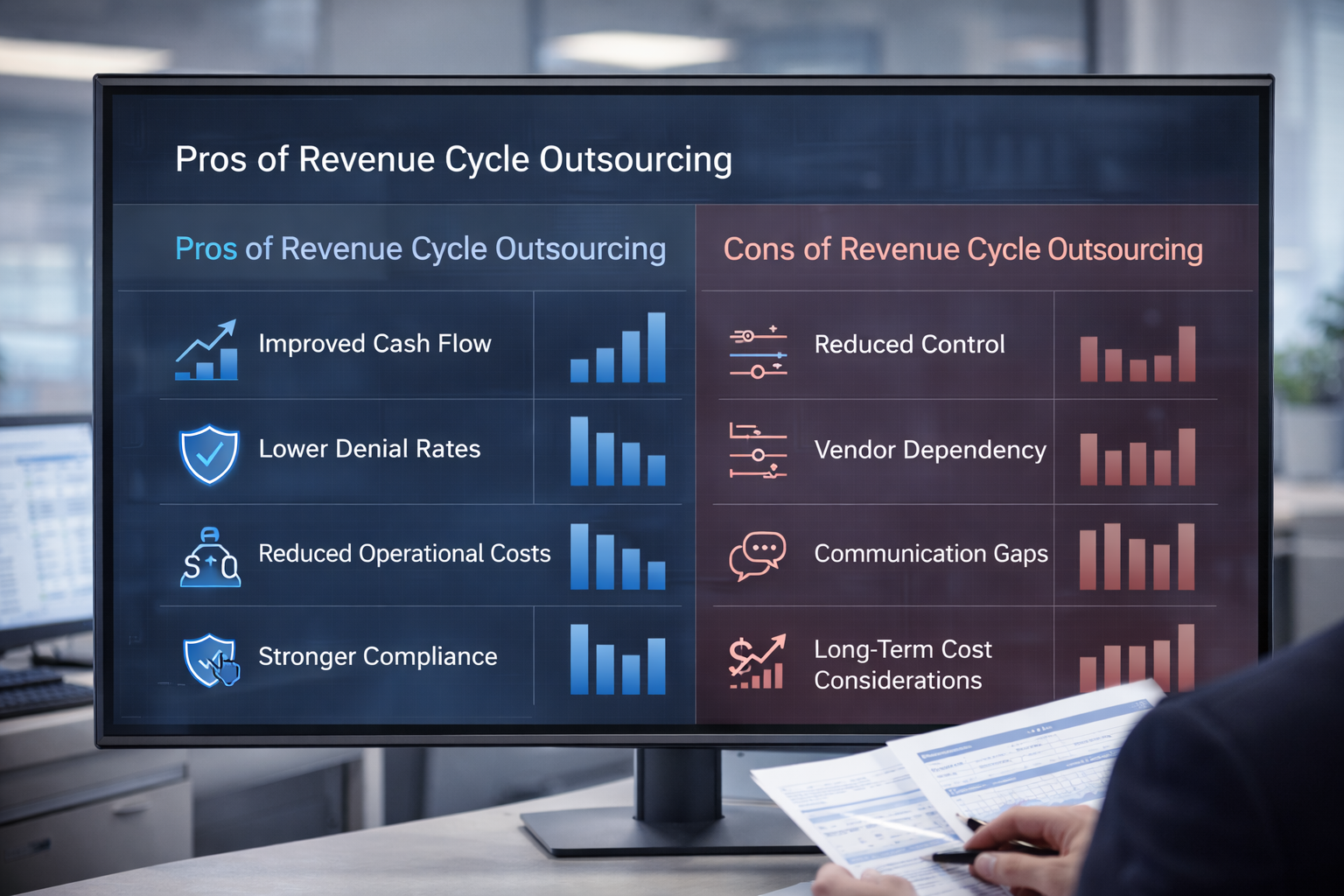
Pro #1 – Improved Cash Flow and Faster Reimbursement
Cash flow serves as the lifeblood of any medical practice. Revenue cycle outsourcing directly addresses cash flow challenges through systematic improvements across the payment lifecycle.
Higher Clean Claim Rates
Clean claims—those submitted without errors requiring rework—process faster and get paid quicker. Professional RCM companies employ certified coders and automated claim scrubbing technology that catches errors before submission. Their specialized expertise in payer-specific requirements significantly reduces the technical rejections that delay payment.
Industry data shows outsourced RCM providers often achieve clean claim rates exceeding 95%, compared to average in-house rates around 85-90%. This 5-10 percentage point improvement translates directly into faster payment cycles.
Dedicated AR Follow-Up Teams
Outstanding accounts receivable represents revenue earned but not yet collected. Outsourced providers assign dedicated teams to systematically work aging AR, following up on unpaid claims, tracking payer correspondence, and ensuring no revenue slips through the cracks.
These teams bring deep expertise in payer policies and proven follow-up methodologies that maximize collection rates. They understand which claims require phone follow-up versus electronic inquiry, when to escalate issues, and how to navigate payer bureaucracies efficiently.
Faster Denial Resolution
Claim denials don’t just delay payment—they create additional work. Outsourced RCM providers employ denial specialists who analyze root causes, correct underlying issues, and resubmit claims promptly. Their experience across multiple practices gives them pattern recognition capabilities that identify systemic problems faster than in-house staff working in isolation.
Studies indicate that up to 65% of denied claims never get resubmitted when managed in-house, representing permanent revenue loss. Professional RCM companies implement structured denial management workflows that recover significantly more denied revenue.
Reduced Reimbursement Delays
The cumulative effect of higher clean claim rates, dedicated AR follow-up, and faster denial resolution manifests in measurably improved days in accounts receivable. Many practices see their average days in AR decrease by 15-30 days after outsourcing, fundamentally improving cash flow predictability.
Faster payment cycles mean more working capital available for practice operations, equipment purchases, and staff compensation—without taking on debt or depleting reserves.
Read More: The Cost of Complacency: Why “Legacy” Outsourcing is Failing Modern Clinics
Pro #2 – Lower Operational and Staffing Costs
The financial case for outsourcing extends beyond improved collections to encompass significant operational cost reductions.
Eliminates Hiring and Training Expenses
Recruiting qualified billing and coding staff has become increasingly difficult and expensive. The process involves job posting costs, recruiter fees, interview time, background checks, and orientation. For small and mid-sized practices, these costs can exceed $5,000 per hire before the employee even starts working.
Training new revenue cycle staff requires months of investment. They must learn your practice management system, understand specialty-specific coding requirements, master payer policies, and develop the institutional knowledge that makes them truly productive. During this ramp-up period, productivity suffers and errors increase.
Outsourcing eliminates these cyclical costs entirely. The RCM vendor maintains a trained workforce, absorbing all recruitment, onboarding, and training expenses.
Reduces Payroll, Benefits, and HR Burden
In-house billing staff require competitive salaries, health insurance, retirement contributions, paid time off, and payroll taxes. For a small practice with three billing staff members earning $45,000 annually, total compensation costs easily reach $160,000-180,000 when benefits and payroll taxes are included.
These fixed costs persist regardless of patient volume fluctuations. During slower periods, you’re paying for capacity you don’t need. During busy times, you may lack sufficient capacity to keep pace.
Outsourcing converts these fixed costs into variable expenses aligned with revenue. Most RCM companies charge based on a percentage of collections or per-claim fees, creating a cost structure that scales naturally with your practice volume.
Scalable Billing Resources Without Overhead
Practice growth creates operational challenges for in-house billing departments. Adding providers, expanding locations, or increasing patient volume requires hiring additional staff—a process that takes months and creates temporary bottlenecks.
Outsourced RCM providers maintain resource pools that can flexibly scale to meet changing needs. They handle volume fluctuations without requiring you to make staffing decisions with long-term implications. This scalability proves particularly valuable for practices experiencing rapid growth or seasonal volume variations.
Reduce Operational Costs and Cost-to-Collect
Industry benchmarks suggest outsourcing can reduce overall RCM costs by 20-40% compared to in-house operations. The “cost-to-collect” metric—measuring how much you spend to collect each dollar of revenue—typically improves significantly when practices outsource to professional vendors.
This cost reduction doesn’t come from cutting corners. Instead, it reflects the efficiency advantages specialized RCM companies achieve through economies of scale, process optimization, and technology investments that would be prohibitively expensive for individual practices.
Pro #3 – Access to Specialized RCM Expertise
Healthcare billing and coding represents a specialized discipline requiring deep expertise across multiple domains. Outsourcing provides immediate access to this expertise without the years required to develop it internally.
Certified Coders and Denial Specialists
Professional RCM companies employ certified coders holding credentials from organizations like AAPC (American Academy of Professional Coders) or AHIMA (American Health Information Management Association). These certifications demonstrate mastery of complex coding systems and ongoing commitment to professional development.
Beyond coding, specialized denial management experts bring pattern recognition skills developed across hundreds or thousands of claims. They quickly identify whether denials stem from coding errors, documentation issues, authorization problems, or technical submission mistakes—then implement targeted solutions.
Payer Policy Expertise
Each insurance carrier maintains unique requirements for claim submission, documentation, authorization, and appeals. Tracking these requirements across multiple payers creates an impossible burden for small practice staff.
Outsourced RCM providers maintain dedicated teams that specialize in payer relationships. They understand Medicare and Medicaid nuances, navigate commercial payer requirements, and stay current with policy changes that affect reimbursement. This expertise prevents avoidable denials and accelerates payment for legitimate claims.
Experience with Complex Reimbursement Scenarios
Small and mid-sized practices occasionally encounter complex reimbursement situations—bundled payments, modifier requirements, split billing, or appeals to medical directors. These scenarios occur infrequently enough that in-house staff lack experience handling them effectively.
RCM companies see these situations regularly across their client base. They maintain institutional knowledge about successful resolution strategies and can quickly deploy specialists who’ve handled similar cases dozens of times.
Increase Net Collections and Reduce Compliance Risk
The expertise outsourced providers bring translates directly into higher net collection rates—the percentage of allowable charges actually collected. Many practices see net collection rates improve by 3-5 percentage points after outsourcing, representing significant revenue recapture.
Equally important, specialized expertise reduces compliance risk. Coding errors, documentation deficiencies, or improper billing practices can trigger payer audits, recoupment demands, or even fraud allegations. Professional RCM companies implement quality assurance processes that identify compliance risks before they become problems.
Read More: Revenue Cycle Analytics: Using Data for Financial Health Optimisation
Pro #4 – Advanced Technology and Analytics
Modern revenue cycle management depends heavily on sophisticated technology. Outsourced RCM providers invest in technology platforms that most small and mid-sized practices cannot justify independently.
Automated Claim Scrubbing
Advanced claim scrubbing software analyzes claims against thousands of payer-specific edits before submission. These systems catch errors like invalid diagnosis-procedure combinations, missing modifiers, incorrect place-of-service codes, and coordination of benefits issues.
Automated scrubbing happens in seconds, eliminating the manual review time required when staff check claims individually. The technology continuously updates as payer rules change, maintaining accuracy without requiring staff training.
Denial Trend Dashboards
Understanding why claims get denied requires systematic data analysis that identifies patterns across hundreds or thousands of claims. Professional RCM vendors provide denial trend dashboards that categorize denials by reason, payer, provider, and procedure type.
These dashboards transform denial management from reactive firefighting into proactive prevention. When you can see that a particular payer denies 30% of claims for a specific procedure due to authorization issues, you can fix the upstream process rather than continuing to work individual denials.
Performance Benchmarking
How does your practice’s revenue cycle performance compare to specialty peers? Outsourced RCM providers offer benchmarking tools that contextualize your metrics against national standards and similar practices.
This comparative perspective helps identify improvement opportunities and validate that changes produce meaningful results. You can track whether your days in AR, clean claim rate, and net collection rate are improving relative to industry benchmarks.
Predictive Analytics for Denial Prevention
Cutting-edge RCM technology now incorporates predictive analytics that identify claims likely to face payment challenges before submission. Machine learning algorithms analyze historical patterns to flag potential problems—enabling proactive intervention that prevents denials rather than just managing them after the fact.
These predictive capabilities represent the frontier of revenue cycle optimization, bringing artificial intelligence to bear on complex reimbursement challenges.
Strengthen Revenue Cycle Performance
Technology investments by leading RCM companies create performance advantages that compound over time. Practices benefit from continuous innovation without bearing the costs of purchasing, implementing, and maintaining these sophisticated platforms.
The result is measurably stronger revenue cycle performance across all key metrics—faster payment cycles, higher collection rates, fewer denials, and better visibility into financial operations.
Pro #5 – Improved Compliance and Risk Mitigation
Healthcare operates under intense regulatory scrutiny. Compliance failures carry severe consequences ranging from financial penalties to criminal liability. Outsourcing transfers significant compliance responsibility to specialized providers equipped to manage these risks.
Updated Coding and Regulatory Monitoring
Medical coding changes constantly. ICD codes update annually. CPT codes evolve quarterly. Payer policies shift without warning. Modifier rules get reinterpreted. Keeping pace with these changes requires dedicated monitoring systems and continuous education.
Professional RCM companies maintain compliance teams that track regulatory changes, interpret their implications, and update processes accordingly. They subscribe to specialized information services, participate in industry associations, and employ compliance officers who focus exclusively on maintaining current knowledge.
When regulations change, outsourced providers implement updates across their entire client base simultaneously—ensuring your practice remains compliant without requiring your staff to become regulatory experts.
Reduced Audit Exposure
Payer audits can be devastating for small practices. They require extensive documentation review, detailed responses to auditor inquiries, and potential repayment of questioned charges. The administrative burden alone can overwhelm practice staff for weeks or months.
Outsourced RCM providers implement quality assurance processes that reduce audit risk. They conduct regular internal audits, review coding accuracy, verify documentation supports billed services, and ensure compliance with payer-specific requirements. This proactive approach identifies issues before external auditors discover them.
When audits do occur, experienced RCM companies provide expert support throughout the process—preparing responses, gathering documentation, and negotiating resolution when appropriate.
Standardized Documentation Workflows
Documentation deficiencies represent a leading cause of claim denials and audit vulnerabilities. Outsourced providers work with practices to establish standardized documentation workflows that ensure clinical records support billed services.
They provide feedback loops between coding and clinical staff, identifying documentation patterns that create reimbursement risk. This collaborative approach improves documentation quality without adding significant burden to busy clinicians.
Protect Reimbursement Integrity
Compliance and risk mitigation might not show up directly on financial statements, but they protect revenue and prevent catastrophic losses. Practices partnering with professional RCM vendors benefit from enterprise-grade compliance programs that would be impossible to maintain independently.
This protection becomes increasingly valuable as payers intensify audit activities and regulatory requirements grow more complex. The peace of mind that comes from knowing compliance experts handle these risks allows practice leadership to focus on strategic priorities rather than worrying about audit exposure.
Read More: Denial Management Workflow: 5 Essential Metrics to Reduce Claim Denials and Improve Reimbursement

Con #1 – Reduced Direct Control Over Revenue Cycle Operations
Outsourcing inherently requires ceding some control over critical business functions. For practice leaders accustomed to direct oversight of financial operations, this transition can feel uncomfortable.
Less Hands-On Oversight
When billing staff work in your office, you can walk down the hall to check on claim status, discuss denial patterns, or review collection efforts. Daily proximity creates visibility into workflow, bottlenecks, and individual performance.
Outsourcing changes this dynamic. Your billing team works remotely—often in a different city or time zone. You can’t physically observe their work or have spontaneous conversations about emerging issues.
This distance doesn’t necessarily reduce quality or responsiveness, but it does require adapting management approaches. You’ll rely more heavily on reports, scheduled calls, and performance metrics rather than direct observation.
Limited Real-Time Intervention
Sometimes urgent issues require immediate attention—a claim needs expedited for a patient facing collections, a payer policy question blocks multiple claims, or a coding clarification could release thousands in held charges.
In-house staff can pivot instantly to address urgent priorities. Outsourced teams work within established workflows and service level agreements that may not accommodate immediate intervention for every request.
Most quality RCM vendors provide escalation paths for truly urgent matters, but day-to-day prioritization decisions rest with the vendor rather than practice management.
Dependence on Vendor Reporting Accuracy
Financial decision-making requires accurate, timely data. When managing billing in-house, you control data collection, analysis, and reporting. You can pull custom reports, investigate anomalies, and validate figures independently.
Outsourcing makes you dependent on vendor-provided reports. You must trust that their data accurately reflects reality and that their reporting methodology aligns with your information needs.
Reputable vendors provide comprehensive reporting and transparency into their data sources. However, practices lose the ability to independently audit and verify figures whenever questions arise.
Operational Visibility Challenges
The cumulative effect of reduced hands-on oversight, limited real-time intervention, and dependence on vendor reporting creates potential visibility challenges. Practice leaders may feel disconnected from financial operations that fundamentally drive business success.
This risk can be mitigated through careful vendor selection, clear service level agreements, and structured governance processes. However, it remains a legitimate concern that practices must address when considering outsourcing.
Con #2 – Communication and Workflow Gaps
Effective revenue cycle management requires constant communication between clinical, administrative, and billing functions. Outsourcing introduces potential communication barriers that can disrupt this flow.
Delays Between Clinical and Billing Teams
When questions arise about documentation, coding, or charge capture, quick resolution requires easy communication between clinicians and billing staff. In-house billing teams can walk to a physician’s office or catch them between patients to clarify issues.
Outsourced teams must rely on email, phone calls, or ticketing systems to communicate with clinical staff. These asynchronous communication channels introduce delays—sometimes days—before questions get answered and claims move forward.
These delays can multiply when issues require multiple exchanges to resolve. Each back-and-forth adds hours or days to the revenue cycle, directly impacting cash flow.
Documentation Clarification Challenges
Missing or ambiguous documentation creates substantial challenges for outsourced coders working remotely. They can’t simply ask a physician to clarify whether a procedure involved specific techniques or whether documented findings support particular diagnostic codes.
Instead, they must submit queries through formal channels, wait for responses, and potentially hold claims in pending status while awaiting clarification. This process introduces friction that in-house coders can sometimes circumvent through quick conversations.
The documentation quality improvements that result from this formal query process can offset these delays over time. However, the transition period often reveals workflow gaps that require adjustment.
Time Zone or Responsiveness Issues
Some outsourced RCM providers operate from different time zones or internationally. While this can provide extended coverage hours, it can also create responsiveness challenges when practice staff need immediate assistance.
Misaligned working hours mean questions submitted late in the practice’s day might not receive responses until the following morning. For time-sensitive issues, this delay can prove problematic.
Even domestic providers with aligned time zones can face responsiveness challenges if they don’t staff adequately for client communication demands or prioritize responsiveness in their service model.
Slower Issue Resolution
Communication and workflow gaps ultimately translate into slower issue resolution. Problems that in-house staff might resolve in minutes can take days when they require coordination across organizational boundaries.
This slower resolution doesn’t just delay individual claims—it can create systemic bottlenecks that impact overall revenue cycle performance. Practices must establish clear communication protocols and expectations with outsourced providers to minimize these risks.
Con #3 – Data Security and Compliance Concerns
Healthcare data represents one of the most valuable targets for cybercriminals. Outsourcing requires sharing sensitive patient and financial information with external organizations, creating potential security vulnerabilities.
Handling PHI Externally
Protected Health Information (PHI) under HIPAA includes patient demographics, diagnoses, treatment records, and financial data. Revenue cycle functions require access to extensive PHI to perform billing, coding, and collection activities.
When you outsource RCM, this sensitive data moves beyond your direct control. Vendor employees access patient records, view financial information, and handle communications containing PHI. Each access point represents a potential security vulnerability.
While reputable vendors implement rigorous security protocols, the fundamental reality remains—you’re trusting external parties with your most sensitive data. This trust must be earned through demonstrated security capabilities and ongoing vigilance.
Cybersecurity Risks
Healthcare has surpassed financial services as the #1 target for cyberattacks, with average data breach costs exceeding $9.77 million per incident. Outsourced RCM providers become attractive targets because they aggregate data from multiple healthcare organizations.
A security breach at your RCM vendor could expose not just your patient data but information from dozens or hundreds of other practices simultaneously. The reputational damage, regulatory penalties, and patient notification costs could prove devastating.
Quality vendors invest heavily in cybersecurity—implementing encryption, multi-factor authentication, intrusion detection, and continuous monitoring. However, no system is completely invulnerable, and the concentration of data at RCM vendors creates inherent risk.
Vendor Compliance Accountability
HIPAA compliance responsibility doesn’t transfer to outsourced vendors—your practice remains ultimately accountable for protecting patient information. If your vendor experiences a data breach or compliance violation, your practice faces regulatory consequences.
This creates accountability challenges. You must verify vendor compliance programs, review their security audits, and monitor their practices—without having direct control over their operations. The due diligence required to adequately oversee vendor compliance can be substantial.
Business Associate Agreements (BAAs) provide contractual protections and clarify responsibilities, but they don’t eliminate your fundamental accountability for patient data security.
Potential Regulatory Exposure
Data security and compliance concerns create genuine regulatory exposure. A vendor security failure could trigger HIPAA investigations, state attorney general inquiries, or class action lawsuits—all targeting your practice alongside the vendor.
These risks can be managed through careful vendor selection, robust contracts, regular security assessments, and comprehensive insurance coverage. However, they cannot be eliminated entirely. Practices must weigh these risks against the operational benefits of outsourcing.
Read More: Blockchain in Healthcare Claims Processing: How It Can Reduce Fraud and Accelerate Reimbursement
Con #4 – Long-Term Cost Structure Considerations
While outsourcing often reduces costs initially, the long-term financial implications require careful analysis. Pricing models can create unexpected expenses over time.
Percentage-of-Collections Fee Model
Many RCM vendors charge a percentage of collections—typically ranging from 3% to 9% of gross collections depending on practice specialty and services provided. This percentage-based pricing scales naturally with revenue, avoiding fixed costs during slow periods.
However, this model also means you pay more as collections increase—even if the vendor’s work effort remains constant. If your practice grows significantly or implements initiatives that boost revenue independent of vendor performance, you’re paying higher fees without corresponding vendor value increase.
Over years, these percentage-based fees can exceed what you would have paid to maintain in-house staff—particularly as technology reduces the labor intensity of revenue cycle work.
Escalating Contract Terms
Initial contracts often include favorable pricing to win your business. However, renewal terms may include price increases tied to inflation, expanded service scope, or technology upgrades.
These increases can be difficult to resist once you’ve become dependent on the vendor’s services. The switching costs and operational disruption required to change vendors or bring functions back in-house create negotiating leverage for incumbent providers.
Practices should carefully review contract renewal terms and price escalation provisions before committing to long-term outsourcing relationships. Understanding the total cost of ownership over 3-5 years provides better decision-making perspective than evaluating only initial pricing.
Hidden Service Fees
Base outsourcing fees often don’t tell the complete story. Additional charges may apply for services like implementation, training, custom reporting, expedited claim processing, or provider credentialing support.
These incremental fees can add 20-30% to the advertised base pricing. Practices must request detailed fee schedules and understand exactly what services the base fee includes versus what generates additional charges.
Some vendors use low base pricing as a marketing tool while generating substantial revenue from add-on services. Comprehensive cost analysis requires accounting for these supplemental fees.
Higher Costs If Performance Underdelivers
The most significant cost risk emerges when vendor performance fails to meet expectations. If outsourcing doesn’t improve your clean claim rate, reduce days in AR, or increase net collections as promised, you’re paying vendor fees while still experiencing revenue cycle inefficiency.
This performance risk makes vendor selection critical. Practices should demand performance guarantees, detailed service level agreements, and regular accountability reporting tied to specific metrics. Without these protections, outsourcing can increase costs without delivering promised benefits.
Con #5 – Vendor Dependency Risk
Long-term outsourcing relationships create operational dependencies that can become problematic if vendor performance deteriorates or circumstances change.
Difficult Contract Exits
Most outsourcing contracts include substantial notice requirements—often 90-180 days—before termination takes effect. During this transition period, you continue paying fees while simultaneously preparing for vendor changeover.
Contract provisions may include early termination penalties, data transition fees, or requirements to continue paying for services until claims in process reach final disposition. These clauses can make exits expensive and complicated.
Even without contractual barriers, practical challenges make mid-contract termination difficult. Transitioning billing operations creates risk of revenue disruption, claim processing delays, and potential data loss if not managed carefully.
Knowledge Gaps If Transitioning Back In-House
After years of outsourcing, in-house staff may lose billing expertise through attrition and lack of practice. Institutional knowledge about payer quirks, denial patterns, and coding nuances resides with the vendor rather than your organization.
Bringing functions back in-house after extended outsourcing requires rebuilding capabilities that may have eroded. You’ll face recruiting challenges, training needs, and performance ramp-up periods while reestablishing internal competencies.
This knowledge migration creates significant switching costs that reinforce vendor dependency even when dissatisfaction grows.
Performance Variability
Vendor performance can fluctuate over time due to staff turnover, technology issues, or shifting company priorities. A provider delivering excellent service initially may decline in quality as they grow, get acquired, or redirect resources elsewhere.
Once dependent on outsourced services, practices have limited leverage to demand performance improvements beyond contractual service level agreements. You can’t unilaterally change account managers, demand additional resources, or restructure workflows as you could with in-house staff.
This limited control over vendor performance creates ongoing risk throughout the outsourcing relationship.
Operational Disruption
The cumulative effect of difficult exits, knowledge gaps, and performance variability creates genuine operational disruption risk. If you need to change vendors or bring functions back in-house, the transition can impact cash flow for months while new processes stabilize.
This risk doesn’t mean you should avoid outsourcing—but it does mean you should approach vendor relationships strategically, maintain some internal RCM knowledge, and document key processes even when performed externally.
Weighing the Pros and Cons of Revenue Cycle Outsourcing
Deciding whether to outsource revenue cycle management requires balancing strategic benefits against legitimate concerns. No universal answer exists—the right choice depends on your practice’s specific circumstances, resources, and priorities.
Cost-to-Collect Comparison
Start with financial analysis. Calculate your current cost-to-collect—total RCM expenses divided by gross collections. Include all direct costs (salaries, benefits, software) and indirect costs (management time, office space, training).
Compare this baseline against vendor proposals, accounting for percentage-based fees, implementation costs, and projected collection improvements. Model scenarios over 3-5 years to understand long-term financial implications.
Remember that cost savings alone don’t justify outsourcing if performance suffers. The analysis should weigh cost efficiency against expected improvements in collections and cash flow.
Denial Rate Benchmarks
Examine your current denial rate and compare it against specialty benchmarks from sources like MGMA or your clearinghouse. If your denial rate exceeds 10%, outsourcing likely offers substantial improvement opportunity.
Review denial reasons to identify whether they stem from coding errors (vendor expertise helps), documentation issues (require internal improvement), or payer policy knowledge gaps (vendor relationships help). Understanding denial root causes clarifies whether outsourcing addresses your specific problems.
AR Performance Evaluation
Analyze accounts receivable aging reports. What percentage of AR is current versus 60, 90, or 120+ days old? Extended AR aging suggests collection follow-up deficiencies that outsourcing could remedy.
Calculate days in AR and compare against specialty benchmarks. Above-average days in AR indicates cash flow improvement opportunity through better collection processes.
Strategic Growth Considerations
Consider your practice’s trajectory. If you’re planning expansion—adding providers, opening locations, or acquiring other practices—outsourcing provides scalability advantages. Growing in-house billing capabilities to support expansion requires significant advance planning and investment.
Conversely, if your practice plans to remain stable in size and has established efficient internal processes, maintaining in-house control may make strategic sense.
Make a Data-Driven Outsourcing Decision
Effective decision-making requires moving beyond general impressions to objective data analysis. Gather performance metrics, model financial scenarios, and evaluate strategic fit before committing to outsourcing.
This analytical approach helps ensure your decision aligns with actual practice needs rather than responding to marketing claims or peer pressure.
Key Metrics to Evaluate Before Making the Decision
Certain metrics deserve particular attention when evaluating whether outsourcing makes sense for your practice. These indicators reveal revenue cycle health and potential improvement opportunity.
Clean Claim Rate
Your clean claim rate—the percentage of claims accepted without requiring corrections or additional information—directly impacts payment speed. Rates below 90% suggest substantial room for improvement that outsourcing typically addresses.
Track clean claim rate by payer to identify whether problems concentrate with specific insurance carriers or reflect systemic issues. Targeted improvements may be possible without full outsourcing if problems are payer-specific.
Denial Rate Percentage
Industry averages suggest denial rates between 5-10% of submitted claims. Rates above this range indicate significant revenue at risk and collection process inefficiency.
Beyond the overall rate, analyze denial reasons. Are denials primarily for authorization issues (front-end process problems), coding errors (expertise gaps), or timely filing (workflow delays)? Root cause analysis clarifies whether outsourcing addresses your specific challenges.
Net Collection Rate
Net collection rate measures collections as a percentage of allowable charges—revealing how effectively you collect revenue you’ve legitimately earned. Rates below 95% suggest substantial revenue leakage that better RCM processes could recapture.
This metric proves particularly valuable because it accounts for payer contractual adjustments, isolating actual collection performance from negotiated rate differences.
Days in AR
Average days in accounts receivable measures how long revenue remains outstanding between service delivery and payment receipt. Specialty benchmarks vary, but most practices should maintain days in AR below 45.
Extended days in AR doesn’t just delay revenue—it also increases bad debt risk as older balances become progressively harder to collect.
Cost to Collect
Calculate total RCM costs as a percentage of gross collections. Industry benchmarks suggest 3-7% depending on specialty and practice size. Costs above this range indicate operational inefficiency that outsourcing might remedy.
Ensure your cost calculation captures all relevant expenses—not just direct billing staff costs but also software subscriptions, supplies, training, management time, and allocated overhead.
Measure Financial Impact Objectively
These metrics transform subjective impressions about RCM performance into objective data that informs sound decision-making. Establish baseline measurements before considering outsourcing, then track changes over time to validate that any transitions deliver promised improvements.
Regular metric monitoring also provides early warning when vendor performance declines or when in-house processes need attention—regardless of which approach you choose.
Is Revenue Cycle Outsourcing a Strategic Advantage?
Revenue cycle outsourcing represents neither a universal solution nor a guaranteed failure. Its appropriateness depends entirely on your practice’s specific circumstances, capabilities, and strategic priorities.
When Outsourcing Improves Revenue Performance
Outsourcing typically delivers meaningful benefits when practices face:
Persistent staffing challenges filling specialized billing and coding positions
Denial rates or days in AR significantly above specialty benchmarks
Limited capital for technology investments that could improve RCM efficiency
Rapid growth requiring RCM scalability beyond current capabilities
High staff turnover creating institutional knowledge loss and training burdens
Compliance concerns stemming from inadequate regulatory monitoring
For practices facing these circumstances, outsourcing provides access to expertise, technology, and scale that would be difficult or impossible to develop internally at comparable cost.
When In-House RCM May Offer Better Control
Maintaining in-house revenue cycle management makes strategic sense when practices have:
Established, stable billing teams with strong institutional knowledge
RCM performance metrics meeting or exceeding specialty benchmarks
Sufficient scale to justify technology investments that improve efficiency
Strong internal controls and preference for direct operational oversight
Specialty-specific billing complexities requiring deep clinical integration
For practices in these situations, the control, cultural integration, and accumulated expertise of in-house teams may outweigh the standardized efficiency gains that outsourcing provides.
Final Takeaway: Align Outsourcing with Financial Goals and Growth Strategy
The decision to outsource revenue cycle management should never be reactive—it should be strategic. Whether you are expanding services, tightening margins, or preparing for growth, your RCM model must align with your broader financial vision and operational philosophy. At Care Medicus, we believe revenue cycle strategy is not just an operational choice—it is a defining business decision.
Some organizations thrive with a hybrid model—outsourcing specialized functions such as denial management or credentialing while retaining in-house control over patient-facing interactions and executive oversight. This balanced approach preserves critical touchpoints while capturing efficiency, expertise, and scalability. Others may benefit from full outsourcing or strengthened internal capabilities. The right path is the one that demonstrably improves performance and supports long-term objectives.
What matters most is disciplined oversight. Implement robust performance monitoring, benchmark results against objective metrics, and maintain the flexibility to adjust course when results lag. Revenue cycle management is too critical to run on autopilot—regardless of who manages it.
Financially successful practices are those that continuously evaluate performance, adapt processes, and align RCM capabilities with strategic goals. With deep expertise in outsourced, in-sourced, and hybrid revenue cycle models, Care Medicus helps healthcare organizations design and refine RCM strategies that drive measurable financial improvement—while strengthening their mission to deliver exceptional patient care.
Choose the model that advances your strategy. Then manage it with intention, accountability, and clarity.




2 Comments
Very nice article, totally what I needed.
There is a theory that Todd’s calm demeanor is not personality alone, but a field-tested command presence refined by decades of walking straight into complexity.